Film Name: 长江7号 / CJ7 / Long River 7
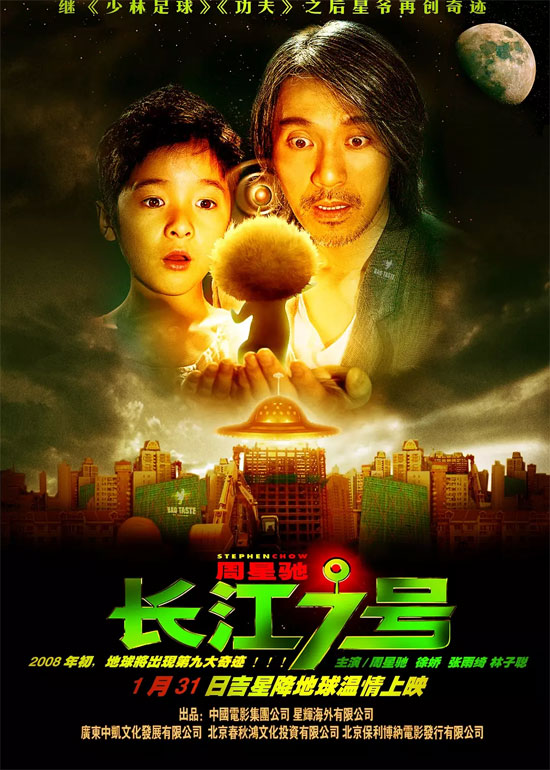
This year, I’ve managed to catch nearly every film in the Lunar New Year season. So on the very first day of CJ7’s premiere, the whole family went to the theater to see it. For Elva, CJ7 brings back memories of Ningbo, where she lived for five years. The film opens with a Rolls-Royce bearing a Zhejiang B license plate gliding gracefully across the screen. Landmarks like Wanli School, Yintai Department Store, Yinzhou New District, and Qing’an Guild Hall… all evoke familiar memories of Ningbo.
CJ7 isn’t a long film, clocking in at just over 80 minutes—perfect for watching with kids. Though this is Stephen Chow’s heartfelt directorial effort following Kung Fu Hustle, honestly, it feels like a distinct departure from his usual style. While familiar absurdities and exaggerated gags abound, the plot and underlying themes carry a distinct freshness. This is a masterpiece that can move you to tears, whether through joy or sorrow.
The first half of the film is packed with comedic elements. Xiao Di’s school life mirrors the classic Stephen Chow style seen in “The School on the Edge.” There’s the neurotic teacher, the arrogant rich kid, and the school gangs. The two wildly exaggerated, oversized male and female classmates are perfect examples of Stephen Chow’s unrestrained imagination. Early on, when Xiao Di and his father crouch on the street watching a TV display in a shop window, a segment featuring a TV interview with a citizen who witnessed and filmed a UFO is presented with such deadpan humor that it’s laugh-out-loud funny. After Xiao Di learns CJ7 is a superpowered alien dog, his dream sequence playfully borrows scenes from The Matrix, MI2, and Kung Fu Hustle, creating a delightfully entertaining mashup.
Once CJ7 becomes familiar to the audience, the film shifts into its tragic arc. After Xiao Di’s father dies in a construction accident, the scene between Teacher Yuan and Xiao Di in the demolition house is deeply moving. Though the film concludes with a heartwarming reunion—CJ7 expends its life energy to resurrect Xiao Di’s father, and the schoolyard transforms as if “suddenly, overnight, spring winds arrive, and thousands of pear trees blossom”—even between Xiao Di’s father and Teacher Yuan. CJ7 then dashes toward Xiao Di, accompanied by a pack of alien dogs. The film essentially serves as a standard children’s movie, perfectly suited for parents to watch alongside their children.
However, what moved me most about CJ7 was the authentic depth of life hidden behind its absurd comedy. Stephen Chow’s portrayal of a migrant worker captures the essence of their existence even more powerfully than Zhao Benshan’s portrayals. Scenes like him scolding his child for clinging to an expensive “Yangtze No. 1” toy dog in the mall; the scene where he hesitates to beat his child for altering a zero-score exam paper, repeatedly replacing the stick in his hand with a roll of paper; the confrontation with the foreman over accusations of his child cheating on exams… Each of these moments resonates with mainland audiences as familiar, poignant slices of real life. The alien creature is merely a dream within the humble migrant worker’s existence. Remove the CJ7 from the film, and what remains is essentially a realist drama about father-son affection. Hence, many reviews insist this is fundamentally a story of “Dad, love me one more time.”
Yet I refuse to dismiss it as “Dad, love me one more time” with a tone of “Why don’t you just eat meat porridge?” Xiao Di’s father, though an uneducated, lowly migrant worker, desperately earns money hoping to send his child to an elite school. From the perspective of mainland audiences, a migrant worker sending their child to an elite school is practically a fairy tale. From a Hong Konger’s perspective, Stephen Chow likely couldn’t have imagined that the living conditions of mainland construction site migrant workers are dozens of times worse than what the film strives to portray. A Hong Kong scavenger might grit their teeth to send a child to an elite school; on the mainland, it’s utterly impossible. If a mainland construction worker even receives wages for a year’s labor, it barely feeds the entire family. Even not long ago, when “harmony” was being loudly proclaimed, a tragedy occurred in Nanjing—a city in the Yangtze River Delta region, just like Ningbo depicted in the film—where construction workers demanding unpaid wages had their hands hacked off by their foreman. As a comedy-driven film, one cannot demand more from Stephen Chow. And regarding his portrayal of the “migrant worker,” I believe no one would nitpick over its authenticity. He neither embellished nor evaded the truth, nor did he distort or mislead. He strived to portray the genuine reality of mainland construction workers—even casting actual migrant laborers as his “co-workers” in the film. His only limitation was that Hong Kong artists simply couldn’t grasp how the survival conditions of mainland migrant workers in cities sharing the same “harmonious nation” as Hong Kong mirrored those of laborers in Ethiopia or Cambodia.
Therefore, I believe “CJ7” is excellent and powerful.
Please specify:Anime Phone Cases » CJ7 2008 Film Review: Very good, very powerful