Film Name: 爆裂刑警 / Bullets Over Summer
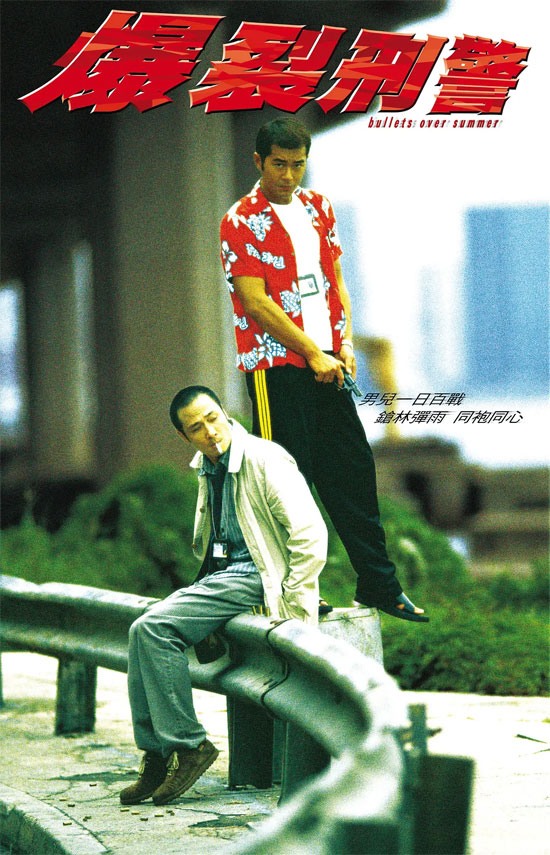
This film is entirely a one-man show by Tony Leung. His precise acting makes the sluggish and loose plot forgettable, makes his co-star Louis Koo appear shallow and inexperienced, and even makes veteran actors like Brigitte Lin quietly fade into the background (Brigitte Lin won the Hong Kong Film Award for Best Actress for this film). With this outstanding performance, he earned a nomination for Best Actor at the 19th Hong Kong Film Awards. (He lost that year to Andy Lau’s performance in Running Out of Time)
Unlike typical cop thrillers, this film prioritizes character development and psychological depth over conventional crime-solving. Tony Leung portrays a fearless, intelligent police officer who falls for a single mother, only to discover he’s terminally ill. Upon learning his time is short, he resolutely betrays his profession. Choosing money over duty, he releases a criminal to secure funds for the mother and child’s livelihood. Severely wounded, he ultimately dies alone before a vending machine.
The video captures the moment his life’s light slowly fades—a four-minute solo performance. Every Academy Award-winning actor has such iconic solo moments etched into their career. Take Leslie Cheung’s self-questioning monologue, Tony Leung’s seamless long take combing his hair before the mirror, Stephen Chow’s heartfelt “Once upon a time, there was a sincere love,” or Tony Leung Ka-fai’s flamboyant solo dance on stage… These stellar moments remain vividly etched in memory. Wu Zhenyu’s presence differs markedly from theirs. His big-screen persona is often tied to gangster roles, with villains outnumbering heroes. Precisely because of this, his taciturn, menacing aura carries arrogance, bravado, and a neurotic, hysterical cruelty. And then there’s that bone-deep, desperate loneliness.
In artistic works, the moments that most vividly capture loneliness are often intertwined with the scent of death. Tony Leung has “died” numerous times on screen, with his most iconic deaths being Ni Yongxiao in “Infernal Affairs II,” Liang Kun in “Young and Dangerous,” and Mike in this film, “Bullets Over Summer.” Ni Yongxiao’s death is arguably the most brilliant sequence in the entire Infernal Affairs trilogy. Discovering the bug in his brother’s embrace, he must convey shock, agony, and despair in his eyes within mere seconds—an extraordinarily emotional feat. Try it yourself in front of a mirror; most people end up with facial twitches or wildly rolling eyes. Ling Kun’s demise was sudden and disgraceful. A formidable gang leader, he was shot in the head by a rookie cop. The intent was clear: to make the character’s death feel deserved and satisfying. The more arrogant and tyrannical the character, the more humiliating and unjust his death becomes, amplifying the audience’s sense of vindication.
Mike’s death holds no dramatic follow-up, no supporting characters to interact with, and barely a line of dialogue. “I put in the money, so I should get a can of soda. That’s all I wanted.” The entire four-minute script boils down to this: “Staggering to the vending machine, inserting coins, pressing buttons, waiting to die.” A few sparse words. In the delivery room, he saw the woman he loved, handed her his shirt stuffed with cash, and told her to wash it well (a subtle hint to spend the money slowly). Then, without a backward glance, he turned and left. The excruciating pain from his wounds sent waves of dizziness and exhaustion through him. Unconcerned with the puzzled stares around him, he struggled to a corner, waiting for that can of Coke to fall.
Did he need that drink? No. What he needed was to perform the act of “fulfilling his wish”—to find release, to take his final breath. In the time remaining, there was no grimace, no groaning agony. His eyes held only serenity as he embraced death with acceptance. This death differed vastly from his other characters’ fates. It was less about waiting and more about choosing death. This perfectly mirrored his role—a tender-hearted tough guy who sacrificed himself for love.
Please specify:Anime Phone Cases » Bullets Over Summer 1999 Film Review: Wu Zhenyu’s Solo Performance