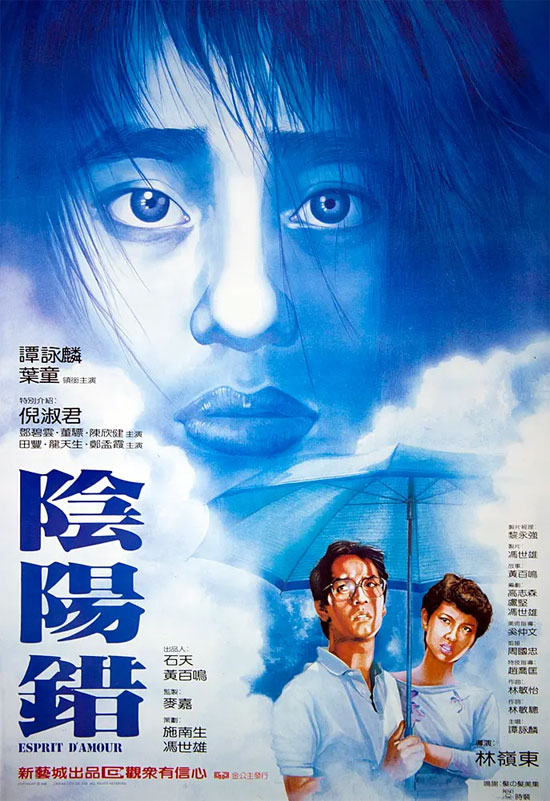
Film Name: 阴阳错 / Esprit d’amour / 陰陽錯
On July 29, the collaborative directorial effort “Eight & A Half” by Hong Kong’s seven major directors—Sammo Hung, Ann Hui, Peter Tam, Yuen Woo-ping, Johnnie To, Ringo Lam, and Tsui Hark—premiered in mainland China. After John Woo withdrew due to health reasons, the project could only be realized as “Eight & A Half,” leaving the ‘seventies’ era “missing” from the film. By the time the film hit theaters, the “seven” in “Eight & A Half” had become “six,” as director Ringo Lam had passed away in 2018—unexpectedly, he left us even sooner than the absent John Woo.
If asked to name the two most “similar” directors in Hong Kong cinema, I would say John Woo and Ringo Lam. Their major works share similar styles and themes; both excelled in gangster/cop/crime genres and were “passionate” about male camaraderie. Chow Yun-fat featured in their most significant films, and their most iconic “CP (dynamic duo)” was consistently Chow Yun-fat and Lee Siu-hean. Before achieving groundbreaking success, both endured years of hard work and experimentation across various film genres. Their later works, however, seemed increasingly strained, as if they were struggling to maintain their legacy. Both ventured into Hollywood, but while John Woo achieved significant success there, Ringo Lam was relegated to making B-movies. Most tragically, their final “encounter” was cut short by John Woo’s illness.
As we head to theaters to commemorate the golden age of Hong Kong cinema and watch Ringo Lam’s final work, let us also revisit the starting point of his filmmaking career—his directorial debut, Esprit d’amour (1983).
Lam’s first two directorial works both featured Alan Tam. The other was “Augusta Ciolli” (1984). At that time, Alan Tam had recently returned to Hong Kong from Taiwan. His singing career was entering its golden age, and he was also making significant strides in the film industry. A major advantage of working with Alan Tam was the opportunity to have him perform the theme songs. Both “Esprit d’amour” and “Augusta Ciolli” featured theme songs sung by Alan Tam, which were exceptionally melodious and earned simultaneous nominations for Best Original Film Song at the 4th Hong Kong Film Awards. At the end of “Augusta Ciolli,” Alan Tam even shared a playful “yin-yang mix-up” joke with Brigitte Lin, which served as an indirect plug for “Esprit d’amour.”
To categorize “Esprit d’amour” by film genre, it could be described as a fusion of romance, comedy, and horror. The romance unfolds in two strands: one featuring a “tiger mom” chosen by “maternal decree,” and another embodying a “ghostly romance.” The comedy comes in two forms: a “husband-wife role reversal farce” where the woman is strong and the man weak, and a “comedy of the living and the dead” where humans and spirits follow different paths. Horror also has two tropes: a Ouija board game and a “ghost-hunting death squad.” Neither is particularly outstanding, but as supporting elements for the romance and comedy, they work well enough.
The three leads—Alan Tam’s “dazed cuteness,” Yip Tong’s fiery temper, and Ni Shujun’s “ghostly wit”—alongside Tong Piu’s “horse racing expertise,” Chan Yan Kin’s “campaign antics,” and the youngster’s precocious charm, are all expertly directed by Lam Ling-tung. Beyond its scares and heartfelt moments, the film delivers plenty of laughs, cementing its place as a chapter in Hong Kong comedy’s golden era of the 1980s.
This promising start to Lam Ling-tung’s directing career was also made possible by the strong backing of Golden Harvest’s “Big Three” (Mike Kar, Stanley Shek, and Raymond Wong), while Ko Chi-sum’s screenplay laid the foundation for the film’s success. Ko Chi-sum also served as one of the film’s assistant directors.
Following “Esprit d’amour,” Ko Chi-sum ascended to directorial duties, launching his career with the hugely successful “The Happy Ghost” (1984). The comedy/horror “formula” of “Esprit d’amour” was nearly replicated in its entirety by “The Happy Ghost.” Thus, in a sense, “Esprit d’amour” served as the ‘precursor’ to the “The Happy Ghost” series. The youthful flair of the “The Happy Ghost” series was another signature trait Ko Chi-sum imbued into it.
Regarding the comedy/horror “formula,” Ringo Lam certainly wasn’t the originator. Sammo Hung’s “Encounter of the Spooky Kind” (1980) and “The Dead and the Deadly” (1982) had already mastered this blend to perfection. Going back further, director Lau Kar-leung’s The Spiritual Boxer (1975) also blended horror elements into its comedic kung fu. Later, the Mr. Vampire series (1985), with Lam Ching-ying as its iconic figure, further popularized the comedy/horror “formula.”
Conversely, infusing romance into the comedy/horror “formula” became the defining feature of “Esprit d’amour.” By the film’s conclusion, although Gu Zhiming (played by Alan Tam) survives, his heart is utterly broken. His “unfinished love affair” with Xiao Yu, set against the film’s closing credits, leaves viewers with an unavoidable sense of sorrow.
Director Lam Ling-tung’s first three films—”Esprit d’amour,” “Augusta Ciolli,” and “Cupid One” (1985)—were all romantic dramas.
“Augusta Ciolli” clearly adapts the plot from the Hollywood classic “Driving Miss Daisy” (1964, based on Shaw’s play “Flower Girl”). The final chase scene featuring JOJO (played by Brigitte Lin) is another homage to “The Graduate” (1967). Raymond Lam’s references and tributes to Hollywood classics are heartfelt. “You have the right not to love me, but you have no right to stop me from loving you.” “Chinese people believe in fortune-telling for the same reason foreigners believe in psychology.” The late, acclaimed screenwriter Wong Ping-yiu also contributed such memorable lines to the film. While the latter statement is exaggerated, it holds some truth—fortune-telling is essentially Chinese-style psychology.
“Cupid One” is a typical “coincidental romance” comedy, fairly average, but the fresh-faced Sam Tsang and Karen Yee are the film’s biggest draws. It turns out Sam Tsang isn’t just capable of playing villains or scumbags—he can also portray a devoted lover.
After delivering three solid romantic films, Lam Ling-tung finally earned the trust of Golden Harvest Studios, landing the helm for the big-budget production “Aces Go Places IV” (1986). A year later, Lam reached his creative peak, releasing two consecutive classics: “City on Fire” (1987) and “Prison on Fire” (1987).
From his directorial debut to delivering cinematic classics, Ringo Lam achieved this ascent in just five years—a pace that left John Woo far behind, as Woo took over a decade to reach comparable heights.
Please specify:Anime Phone Cases » Esprit d’amour 1983 Film Review: Ringo Lam’s debut film, and the precursor to the “The Happy Ghost” series