Film Name: 黑白道 / On The Edge
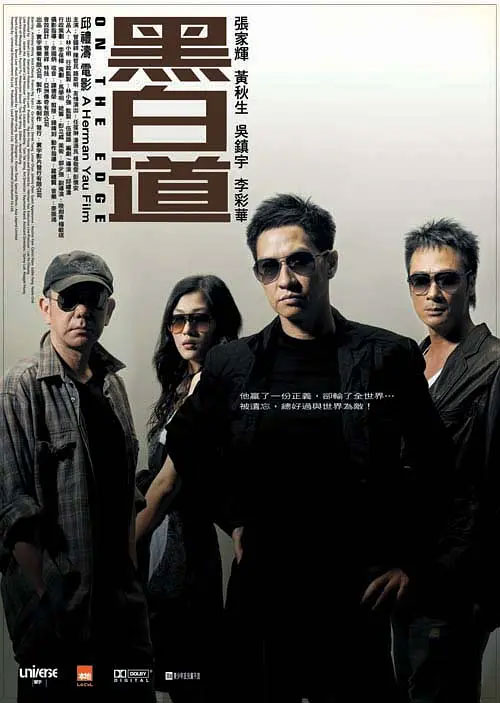
If the theme of “Protégé” is profound, then “On The Edge” delves into the depths of human despair with piercing intensity. While Daniel Wu’s character in ‘Protégé’ carries a sense of uncertainty, Nick Cheung’s portrayal in “On The Edge” embodies a tortured struggle on the brink of life and death—making the English title all the more fitting: on the edge…
“Protégé” is an ensemble piece with many compelling characters: Andy Lau as the boss; Zhang Jingchu as the drug-addicted woman; Louis Koo as the abusive husband; Anita Yuen as Brother Kun’s wife… Yet “On The Edge” feels more like a one-man show. Though it features Sammo Hung as a cop and Tony Leung as a compassionate boss, they blend into the background, becoming invisible. All the spotlight shines on one place—where Hai Zai (Nick Cheung) stands.
Since “Infernal Affairs,” the theme of undercover agents has gained increasing attention. Yet never before has it been portrayed with such raw humanity, such profound disorientation, such relentless bleakness. Perhaps it’s this novelty of a defeated hero that makes me cherish this work so deeply.
The film opens with a shot of Zhang Jiayi collapsing after being shot. People scream, chaos erupts, while his own gaze remains utterly blank. Soon, I was swept up in the film’s current, forgetting that initial shot and plot point, fully immersed in the story. What I always remember is the hesitation Hoi-chai (played by Nick Cheung) displayed after putting on the police uniform. He fastened his belt, only to realize his shirt wasn’t tucked in, so he undid the belt and tucked it in again. Only when he finally completed the uniform did tears stream down his cheeks. Despite eight years as a cop, he’d never formally worn the uniform—this was his first time…
After eight years undercover, Hai Zai successfully apprehended the triad boss and returned to the force as a hero, receiving a medal of honor and an award ceremony. Yet the ceremony felt so sparse it resembled an underground party operation. Few attended the ceremony. Photos were snapped hurriedly during the presentation, and there wasn’t even a round of applause. The high-ranking officials stood up and left, leaving Hai Zi standing there alone, as if he were not a hero but a criminal…
Though he captured the crime boss and rejoined the force, Hai Zai’s life derailed. No one accepted him. His former colleagues still saw him as a thief, while his new role in the anti-triad unit forced him to revisit places he once frequented, face brothers-in-arms who’d shared life-and-death moments, and confront a girlfriend who treated him like a traitor. Hai’s life crumbled, especially upon learning his former boss—who had once treated him well—had committed suicide in prison because of his arrest. Framed, he sought out his old brothers only to discover the betrayer was none other than one of them. Hai, who had intended to save lives, was instead branded as the one who pushed the criminal off the building. Hai cried out, screaming that he just wanted to be a normal, ordinary cop—why couldn’t he?
I was completely engrossed in the plot, constantly feeling for Hai Zai and worrying about him, yet I had forgotten that opening scene. After resolving the hostage situation, just when he thought he might finally find some peace, he was shot by a hidden gunman. He fell into a pool of blood, staring blankly and confusedly at the sky…
A starkly realistic theme: undercover agents aren’t just heroes, they’re ordinary people. After completing their missions, they face shattered lives. How difficult it is to return to a normal existence… As the poster states: He won back justice, but lost the whole world…
Please specify:Anime Phone Cases » On The Edge 2006 Film Review: The Pain of Undercover Work