Film Name: 黄飞鸿之四:王者之风 / Once Upon a Time in China IV / 黃飛鴻之四王者之風
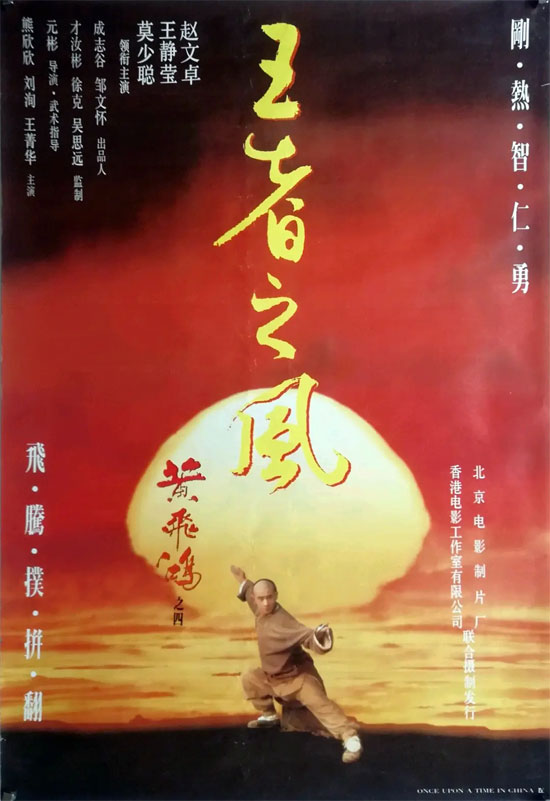
The movie channel aired “Once Upon a Time in China IV,” a 1994 film that still holds up remarkably well today. Zhao Wenzhuo is so adorable! But watching it again after all these years brings a whole new perspective.
Judging from the ending where the Eight-Nation Alliance enters Beijing and the Empress Dowager flees westward, the film depicts events around 1900. Before the Alliance’s entry into Beijing, the Boxer Rebellion erupted fiercely in Beijing and Tianjin. The Red Lantern Society portrayed in the film proclaimed itself as “Supporting the Qing, Exterminating the Foreigners.” Targeting the slaughter of foreigners, it essentially represented a faction within the Boxer movement. Historically, the Red Lantern Society did exist, primarily composed of women from the lower and middle classes of society. They promoted the idea of flying through the air and being impervious to weapons, with the primary goal of slaughtering foreigners. The segments about the Red Lantern Society in the film, aside from participating in the lion dance competition, form a thread that runs through the entire film, intertwining the romantic feelings between the Red Lantern Society’s senior sister and Wong Fei-hung. Yet when the Red Lantern Sect drugged and kidnapped Wong Fei-hung’s family and disciples, weren’t these blatantly thuggish tactics? When the sect’s leader attempted to harm the priest, her ruthlessness was halted by Wong Fei-hung. This demonstrates that martial artists in our country uphold the principle that the benevolent are invincible, not bullying the weak. The Red Lantern Sect itself was not a traditional martial arts faction that revered martial virtue; it was purely a deviant sect.
Regarding the treatment of foreigners, the overseas-educated faction represented by Auntie Fourteen offered a solution: self-reliance while embracing advanced foreign ideas. Her founding of a newspaper promoting women’s rights exemplified this. Unfortunately, ignorance prevailed then, and newspapers were often used merely for packaging goods. Wong Fei-hung advised her that establishing a school must precede a newspaper—a profound truth, for education remains the most potent weapon. Here, we must mention the educational institutions that emerged during that era. Whether it was universities like Shanghai University, St. John’s University, Yenching University, or Fu Jen Catholic University… or renowned secondary schools such as Pei Man Girls’ School, Huiwen Middle School, and St. Mary’s Girls’ School—all were Christian-affiliated institutions. This included hospitals; many of China’s prominent hospitals today trace their origins back to deep connections with the church. From an educational and medical perspective, Western society was ahead of China at that time. Many foreigners came to China with missionary aims, bringing Western civilization and science. While unscrupulous elements undoubtedly existed among them, groups like the Boxers and the Red Lantern Society still made killing foreigners their mission, naively believing that eradicating Westerners and their “heretical ways” would bring universal peace. Naturally, after the Xinhai Revolution, many believed that overthrowing the Qing dynasty would usher in a golden age, unaware of the path ahead. Sun Yat-sen was a clear-eyed visionary. The backward and ignorant populace, along with warring warlords, posed far greater threats than the Qing government itself. (Recently I pondered why Sun Yat-sen is revered as the Father of the Nation. By resigning as provisional president to rebuild the republic, only one untouched by lust for power could truly benefit the people. Contrast this with Yuan Shikai—who could have become the Father of the Nation himself—yet his greed for fame and power swept him against the tide of history, destroying his legacy forever. Thus, the future of the nation remains a contest between the Kuomintang and the Communist Party. This thought was presented to my uncle.)
In the film, Wong Fei-hung’s father declares, “We won this plaque but lost the entire kingdom,” preparing to return south to restore the nation. I recall my high school history teacher mentioning that martial artists could be patriots—figures like Huo Yuanjia and Chen Zhen. Yet their individual efforts couldn’t alter China’s fate. Besides, the era of cold weapons had passed. Neither Southern fists nor Northern legs could match Mauser rifles. Even then, Boxer rebels clung to myths of invulnerability to blades and bullets. Of course the Boxers couldn’t save China! Returning to reality, last year people were still vandalizing Japanese shops and cars. Over a century has passed—has history truly progressed?
The appeal of the Wong Fei-hung film series lies not only in casting and direction but also in the screenwriter’s brilliance. Wong Fei-hung was both a martial arts master and a passionate patriot, yet his patriotism was never blind. He maintained a rational stance toward Western civilization while upholding martial ethics.
Please specify:Anime Phone Cases » Once Upon a Time in China IV 1993 Film Review: Viewing History Through Wong Fei-hung Films