Film Name: 林世荣 / The Magnificent Butcher
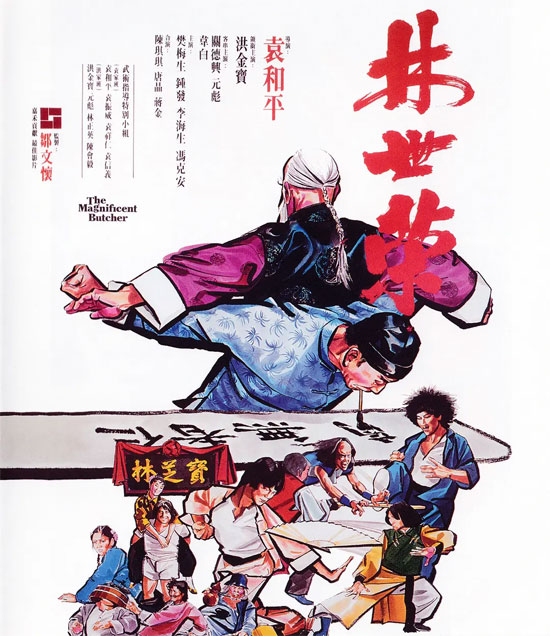
I bought the box set of Sammo Hung’s three classic films: “Encounter of the Spooky Kind,” “The Magnificent Butcher,” and “Knockabout / The Fight.” The latter two were directed by Yuen Woo-ping.
Audiences are very familiar with the name Lam Sai-wing. For years, he has consistently appeared on screen as Wong Fei-hung’s disciple “Pork Chop Wing,” and this film is no exception. Like other Hong Kong martial arts films of the era, this one features a crude and simplistic plot (why must there always be a drunken old man?!), and the chubby Sammo’s martial arts skills aren’t exactly impressive either. The film has two redeeming qualities: first, Kwan Hoi-shan’s portrayal of Wong Fei-hung, though limited in screen time, delivers standout moments; second, the martial arts choreography by master director Yuen and Fatso Hung showcases the Hong Kong stunt community’s spirit of innovation and evolution.
Kwan’s version of Wong Fei-hung naturally lacks the dashing flair of Jet Li’s portrayal, yet it possesses its own masterful presence. In the fight scene against the Five Dragons Sect leader, setting aside the brilliance of Yuen’s choreography, Kwan—at an age no longer young—still delivers rock-solid, unshakable moves. Suspended by wires, he wields his brush with such force that the words “The Benevolent Have No Enemies”—though not particularly elegant—seem to leap off the paper, proving this isn’t mere showmanship. Later, when Lam Sai Wing is caught mimicking his master’s speech, Old Kwan retorts, “I’m leaving. If you can imitate me so well, what use is a master?” This seemingly angry remark is actually dry humor—Huang was heading to Guangxi to buy medicine.
Regarding the martial arts choreography, the aforementioned fight scene stands as the most spectacular segment. Also noteworthy is the interpretation and innovation applied to Hung Gar Kung Fu. The clash between the Thirteen Bridges of Hung Gar and the Formless Cinnabar Palm embodies Chinese philosophical concepts within the combat—hard meets hard, soft overcomes hard… along with the distinct external manifestations of the Five Elements. While perhaps simplistic, it’s certainly not something weapon-obsessed Americans could have conceived.
The bonus features include an exclusive interview with Sammo Hung. After years in Hollywood, the portly Sammo still seems to struggle with polished English, mixing the languages awkwardly—yet his insights ring true. He quips that Americans make movies by “using the money,” while Hong Kong filmmakers do it by “saving the money,” a line that’s downright hilarious. He also notes how Americans once scorned Hong Kong’s use of wirework, only to now rely on it constantly. These observations stem from years navigating both film industries. Contrast this with certain mainland directors who, having at best toured Universal Studios, spout nonsense about the differences between China and America. Hong Kong filmmakers, by comparison, feel more down-to-earth and endearing.
Please specify:Anime Phone Cases » The Magnificent Butcher 1979 Film Review: In the name of Wong Fei-hung’s disciple