Film Name: 天涯海角 / Lost and Found
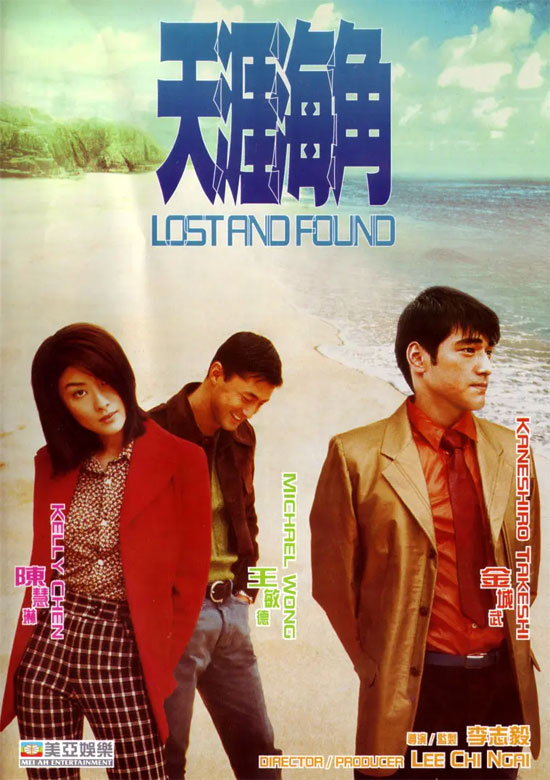
It had been so long since I’d last been moved by a romantic film that I couldn’t help but take this one seriously. When I saw Takeshi Kaneshiro standing on the rocky shore at the edge of the world, his uncertain gaze tinged with a hint of hurt, I was amazed that Kelly Chen hadn’t rushed over yet. The guy said, “The inspection team is conducting a thorough search of the possible areas.” The girl replied, her voice slightly choked, “The price is negotiable.” ” They embraced, and the man sighed with relief, “Search complete.” Perhaps it was the hormones, but I found myself moved to tears.
Immediately after their embrace, the scene shifts to a starkly realistic depiction of the woman’s funeral. So realistic it felt almost like witnessing a resurrection.
A film that reveals miracles in a world devoid of them, a story that offers hope amidst utter hopelessness—how could it not inspire profound emotion?
The film begins on a narrow street in Hong Kong’s impoverished district, specifically with Takeshi Kaneshiro’s character, Ah Chung—a Mongolian immigrant—eagerly rummaging through trash bins for wallets. Leonard Cohen sings with decadent, slightly mocking melancholy: “Dance me to the end of love…” (This song and the slum street scene reappear at the film’s conclusion.) If Ah Chung—a master at finding lost items—shouldn’t have carelessly left his phone on the trash can lid after retrieving the wallet, this mistake is undoubtedly the most beautiful error in the film. I cannot imagine how tragic it would have been for Xiao Qi, the shipowner’s daughter played by Kelly Chen, to die alone and bewildered without ever meeting him.
Xiao Qi ultimately passed away from acute leukemia. The film’s mastery lies precisely here—it tells you miracles don’t exist, yet simultaneously shows how to make miracles happen within your consciousness. After death, Xiao Qi’s spirit circles among the loved ones who cared for her. Soft music plays, creating a profoundly beautiful farewell. She says, “There was a secret he never told me, but now I know what it was. Every little thing around us can be magic, and everyone can be a magician.” Such a farewell insight is surely an affirmation of life.
In this film, everything about the characters and their environment defies all odds. In a Hong Kong slum, a Mongolian immigrant starts a small lost-and-found company, hiring only employees with physical disabilities. Their price list is wildly imaginative, offering services like “organizing inspection teams for thorough searches in potential areas.”
Xiao Qi gradually realizes that Ah Chong’s company isn’t just finding lost items—it’s helping people find their lost hopes. As Ah Chung tells her, someone once paid ten thousand dollars to find a wig, claiming what was truly recovered was self-respect. Benevolent lies are an internal policy at Ah Chung’s company. Like deceiving the dumpling vendor whose wife was presumed dead, telling him she hadn’t been found, yet urging him to pay the search debt—all to keep him from giving up hope, to work hard and provide for his four children. Or helping a little girl tend her mother’s rose garden while the mother battled kidney disease. Though the roses finally bloomed after immense hardship, the girl’s mother still passed away. That scene was profoundly masterful. Chong and Qi waited through the night until the flowers finally opened, convincing them miracles exist. But when they joyfully knocked on the girl’s door, neighbors told them her mother’s condition had worsened—she was in the hospital facing major surgery, with uncertain chances of survival. The pair froze, instinctively drifting apart in opposite directions. For the first time, their faith wavered. Kelly Chen’s voiceover asks: “I’m not sure what we truly achieved—was it for Tingting, for her mother, or for ourselves?” Yet three days later, the girl and her father chose not to bury the roses with her, leaving them in the garden instead.
Hope seemed lost, yet it lingered in the world. Miracles don’t exist, but isn’t hope itself a beautiful thing? It was like Xiao Qi died, but she gave birth to a child for Ah Chong. That child would stay with Ah Chong and Qi’s father in her place. Dance me to the end of love…
Another particularly beautiful scene is when the two sing “Where to Find Penglai” in the karaoke bar. Their gazes grow increasingly deep as they look at each other, and as the song reaches its climax, the pitch gradually lowers. Takeshi Kaneshiro and Kelly Chen’s masterful use of eye contact in this film conveys countless unspoken emotions. Kelly Chen’s first line in the film is: “Ah Chong told me nothing is impossible to find.” Takeshi Kaneshiro’s first line is: “I found it!” (Note: He utters this line with his head still in the trash bin.)
What exactly connects loss and gain to the ends of the earth? Before seeing the film, I pondered this upon reading its English and Chinese titles.
The ends of the earth refer to a small Scottish island. Even its most hopeful corners are decaying, and all the young people have left. They return only to scatter the ashes of the departed or to be brought back as ashes themselves after death. The island is dotted with gravestones. Every headstone faces the sea and the sky. Xiao Qi looked at the photos and asked the local man played by Wang Mindie, “Why do they still want to leave after death? It’s already the end of the world—why go further?” Mindie replied, “Leaving or staying isn’t the issue. Home is always home. No one forgets their homeland. This is my grandfather’s photo. In Scotland, one day each year, the cold ocean currents meet the warm currents flowing out to sea. On that day, they all gather at the cliffs. They let the warm current carry their hearts home. Is this what you wanted to know?”
Later, I finally understood the subtle connection between “the ends of the earth” and “losing and finding again.” Because both point toward hope, while hope and disappointment are only a step apart. A tiny isolated island, where every year people journey from afar to wait for the cold current to turn warm. It’s a miracle of nature, yet a hope for ordinary people. Through nature’s wonders, humans glimpse another possibility of life. The ends of the earth teach us to view life from a different angle. How wondrous nature is! As the movie says: “The wonders of nature aren’t so easily understood.” Ah Chong’s catchphrase is: “If you don’t go looking, you’ll never find it. But really, nothing is truly lost—what in this world is impossible?” So even when hope seems invisible, it doesn’t mean it doesn’t exist.
Bit by bit, hope is right beside us. Nature is truly marvelous.
Please specify:Anime Phone Cases » Lost and Found 1996 Film Review: Hope is found in the little things around us.