Film Name: 大事件 / Breaking News
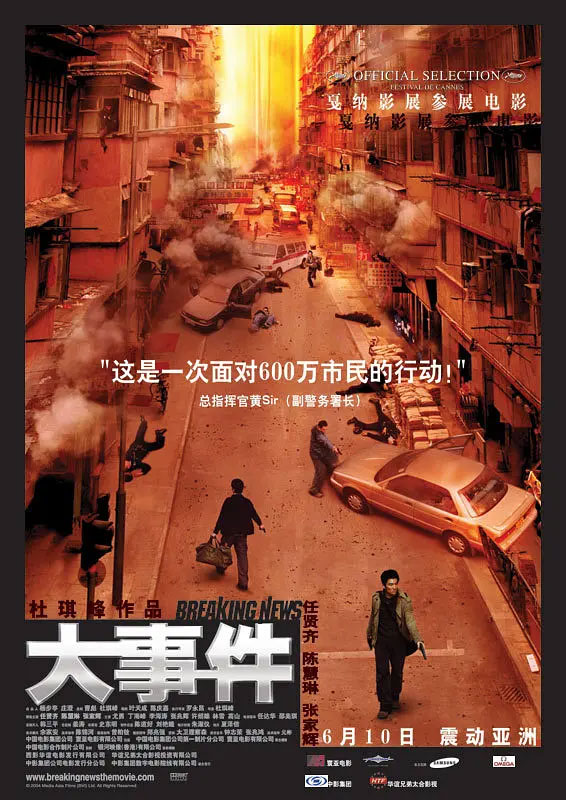
The film “Breaking News” opens with a street gunfight between a gang of robbers and Hong Kong police. What should have been a routine public security incident takes a dramatic turn when a journalist captures footage of a robber pointing a gun at a patrol officer, who then chooses to raise his hands in surrender. From that moment, the incident veers off course, gradually escalating into a full-blown social event.
As the film states: We now live in a media age. Media—meaning channels, outlets, information—brought the image of the surrendering officer into public view, sparking widespread societal debate. People began questioning the Hong Kong Police Force’s competence and grew fearful for their personal safety. The police’s image was undoubtedly severely damaged by this media storm, compelling the force to rebuild its reputation.
The female superintendent portrayed by Kelly Chen embodies a new police ethos. Unlike traditional officers who apprehend criminals behind closed doors, she steps onto the screen, proactively engaging the public eye to capture criminals. Her mission is to rebuild and promote the police force’s image through media channels. Upon her entrance, she delivers the line: “If we fall at the hands of the media, we must rise again through the media.” Based on this line and the subsequent series of actions by the police and criminals, we can interpret this from a communication studies perspective: this is not merely a battle between police and criminals, but a clash between traditional media and new media.
Represented by Kelly Chen, the police embody the traditional media faction. Collaborating with the Public Relations Branch and major television stations, radio networks, newspapers, magazines, and foreign news agencies, they control the lifeline of information dissemination—the traditional gatekeepers. The criminals, represented by Ren Xianqi, along with the hostages, embody the original passive audience consuming traditional media messages. Through the internet, they break the information monopoly of traditional media, voicing their own perspectives online. This also conveys their opinions to the public, sparking intense reactions. The film introduces a third party: the traditional police force, embodied by Nick Cheung. Unaware of or indifferent to media evolution, they fail to leverage media for publicity, block external information, and remain single-mindedly focused on apprehending criminals—fulfilling their duty as officers (later, when the police station staged a publicity stunt by distributing meals, our brother Cheung was still hungry, searching for “bastards”).
This analysis primarily examines the media communication dynamics between the new police force represented by Kelly Chen and the police-criminal hostage group led by Ren Xianqi.
First, the police took the initiative by equipping each commander with cameras. From the moment the mobile command vehicle entered the scene, recording commenced, with footage transmitted to all Hong Kong citizens in real time. The police functioned as traditional media, controlling the channels for public information dissemination and effectively serving as gatekeepers. Gatekeeping theory was first proposed by Kurt Lewin, a renowned American social psychologist and one of the four founding fathers of communication studies, in his work “The Pathways of Social Life.” Levin argued that in studying group communication, information flows through channels containing “gateways.” Within these channels, gatekeepers exist, allowing only information that conforms to group norms or the gatekeepers’ value standards to enter the communication pathway. In actual information dissemination, communicators inevitably filter and screen information from their own perspectives and standpoints. This act of filtering and screening is termed gatekeeping, and those who engage in it are called gatekeepers. Its essence is:
1. News reporting and information dissemination by mass media do not possess pure “objective neutrality.” Instead, they involve selection, processing, and adaptation based on the media outlet’s stance, policies, and value standards.
2. While news and information selection is constrained by factors such as media business objectives, audience demands, and sociocultural influences, content aligned with the media’s policies and interests is more likely to be prioritized for inclusion and dissemination.
3. Media gatekeeping is a multi-stage, organized process. While individual journalists and editors participate, the overall outcome reflects the stance and policies of the media organization.
This role is exemplified in the film’s portrayal: from the moment police surround the criminals in a residential building, law enforcement is effectively on the defensive. Criminals hurl bombs indiscriminately, repeatedly injuring officers. Yet as gatekeepers, the media selectively filtered footage, showing only scenes of police firing at suspects while highlighting so-called “handsome and cool” officers. They digitally enhanced photos, requested the director to re-edit police deployment segments, and added dramatic music. Consequently, audiences only witnessed heroic officers firing at fugitives and cornering them in an apartment—nothing else.
Through live broadcasts of citizen interviews, audiences received curated and re-edited information via traditional media, quickly offering feedback: “With police present, there’s nothing to fear,” “Police arrived within fifteen minutes—swift action,” “Hong Kong remains a safe city”…
Yet the criminals were no less astute. Facing the police’s media offensive, they—as representatives of ordinary audiences—recognized the evolving role of media in modern society. They swiftly shifted their battleground to the internet, using it as their platform to voice their own narrative and launch a counterattack against traditional media: They captured footage of police fleeing in panic during explosions with their phones and recorded themselves dining with hostages. By posting these videos via the hostages’ home networks, they conveyed messages to the public that the police were lying and that they were treating hostages well—attacking the police and seeking sympathy. This information quickly entered the public eye and drew the attention of traditional media, causing the incident to continue escalating. Citizens began accusing the police of deceiving the public, and external discontent grew. The criminal successfully used the internet, this new medium, to break the traditional media’s monopoly on information, weakening the police’s role as gatekeepers.
Faced with this sudden counterattack, the police swiftly countered by redirecting public attention through mass media. They enlisted Jackie Chan as a celebrity endorser to publicly support the police. Simultaneously, they filmed themselves distributing meals and invited journalists to dine with them, conveying the message: “Not only the hostage-takers and hostages need to eat—police are human too, they get hungry and need meals.” They interviewed the families of fallen officers, featuring tearful statements from parents and girlfriends, while filming injured officers facing amputation to elicit sympathy. Most crucially, they located the patrol officer who initially surrendered and gave him a platform to declare his innocence—that he had not violated any police regulations, that the force discourages unnecessary risks, and that being a police officer does not equate to suicide. He further emphasized his responsibilities as a father and husband, needing to care for his wife and children as the pillar of his family. Thus, as the film states: “He who uses the media becomes the hero.”
This also illustrates a classic communication theory—the effects of agenda-setting theory. The “agenda-setting function” as a theoretical hypothesis first appeared in a 1972 paper by American communication scholars M.E. McCombs and Donald Shaw, titled “The Agenda-Setting Function of the Mass Media,” published in the Journal of Communication. This paper summarized their 1968 investigation into how media coverage of the U.S. presidential election influenced voters. That year, McCombs and Shaw studied the presidential race to assess the extent to which the media agenda shaped the public agenda. In 1972, they proposed the agenda-setting theory, which posits that mass communication often cannot determine people’s specific views on an event or opinion. However, it can effectively influence which facts and opinions people focus on and the order in which they discuss them by providing information and organizing relevant topics. While mass communication may not affect how people think, it can influence what people think about. Its main points are:
1) Mass media often cannot determine people’s specific views on an event or opinion, but it can effectively influence their attention to certain facts and opinions, as well as the order in which they discuss them, by providing information and setting the agenda. What news media offer the public is their agenda.
2) The emphasis mass media places on issues and opinions correlates directly with the audience’s perceived importance. This theory emphasizes that audiences adjust their perceptions of an issue’s significance based on media-provided topics, prioritizing action on events deemed important by the media.
3) The alignment between the media agenda and the public’s perception of an issue’s importance is not straightforward; it relates to the extent of media exposure. Individuals who frequently engage with mass media exhibit greater consistency between their personal agendas and the media agenda.
4) Attention should be paid not only to which issues the media emphasizes but also to how these issues are framed. Factors influencing audiences extend beyond the topics highlighted by the media, encompassing both attitudinal and behavioral impacts.
Through agenda setting, the police diverted public attention away from the act of police lying, redirecting it toward the hardships faced by officers and broader discussions about police ethics (regarding the patrol officer who surrendered).
In the film’s conclusion, the police apprehended the criminals, achieving a major success. However, we observe that traditional media, facing intense pressure from modern internet platforms, sees its traditional gatekeeper role challenged and its agenda-setting function diminished. The increasing diversity of media has transformed audiences—once passive recipients of information—into active disseminators. The evolving role of communicators reflects the profound changes in information channels brought about by modern media development.
Please specify:Anime Phone Cases » Breaking News 2004 Film Review: Let’s briefly examine this film from a communication studies perspective.