Film Name: 城市猎人 / City Hunter / Sing si lip yan / 城市獵人
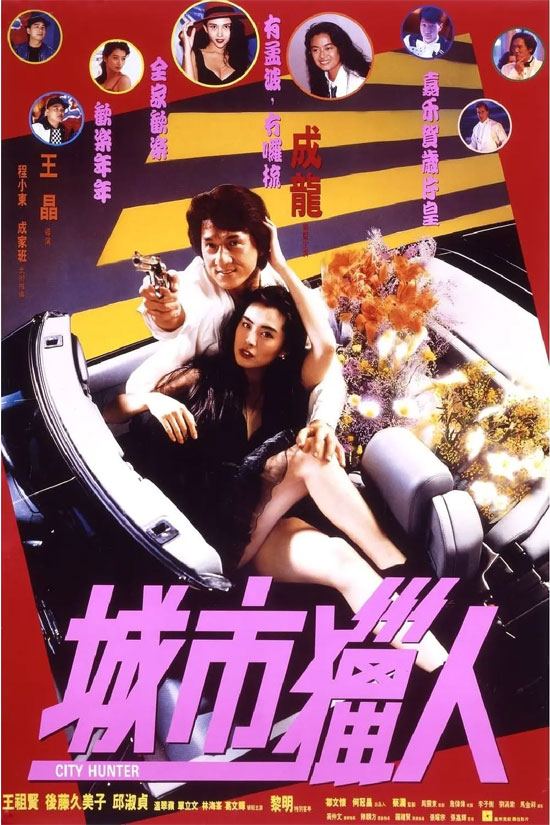
The 1993 Hong Kong comedy film “City Hunter,” adapted from the Japanese anime of the same name, holds a 7.6 rating on Douban and a 6.9 on Mtime.
It’s packed with teenage nostalgia. When I first saw this movie, I was just 20, fresh out of high school and starting college. I watched the VCD version back then, and have since rewatched it two or three times. I know the plot inside out, could recite it backwards. Revisiting it now stirs up a flood of youthful memories.
This film stands uniquely among Jackie Chan’s comedies, brimming with absurd humor. Chan pushes his comedic talents to the extreme, creating a style entirely distinct from his other works. Directed by Wong Jing during his golden era—a time marked by both prolific output and a reputation for producing some of the worst films—it occupies an awkward position in Chan and Wong’s filmographies.
Its place in both Wong Jing and Jackie Chan’s filmographies is awkward—neither truly great nor outright bad. It’s not a terrible film, but it doesn’t have a stellar reputation either. It’s purely a commercial piece. In the late 80s and early 90s, the Japanese manga “City Hunter” was hugely popular, which led to this Hong Kong-flavored spin-off.
While leveraging the “City Hunter” IP, the film features significant Hong Kong-style adaptations, retaining only the core elements of the original manga while taking liberties with the story, resulting in wildly imaginative and unconstrained reinterpretations.
The most unforgettable sequence is undoubtedly the Street Fighter-inspired segment, a true standout. Released during the peak popularity of the Street Fighter arcade game, the film mashes everything together, injecting fantastical elements into what was originally a grounded story. While this makes the film feel disjointed, as a pure commercial production, it’s best not to overanalyze it. If released today, it would likely be savaged by critics.
In 1993, Jackie Chan was 39, at the peak of both his career and physical prowess. His action sequences were spectacular, brimming with speed and explosive energy. The climactic showdown with the main antagonist at the end perfectly blended the intensity of an action film with the humor of a comedy, standing as the film’s crowning action achievement.
At that time, Joey Wong and Chiu Shu-ching were truly stunning, radiating youthful vitality that lingered in one’s dreams. Sammi Cheng was 24 and Joey Wong 23 at the time. However, their acting was still quite raw, especially Joey Wong—she was essentially a pretty face with little substance in her performance. Japanese actress Kumiko Gotō, just 19 then, stood out despite her darker complexion. Her youthful energy was undeniable and left a strong impression.
The song “HAPPY HAPPY GALA GALA” performed by the duo “Soft and Hard Masters” in their cameo appearance is delightful—upbeat, lively, and catchy. Contemporary audiences likely won’t recognize “Soft and Hard Masters,” as their music was rarely introduced to mainland China even in the 1980s and 1990s, leaving them largely unknown domestically.
Viewed today, the film lacks the dazzling impact of its era. Its jokes feel forced and piled on, the director seems careless, the acting lacks commitment, and the editing drags with sloppy pacing. It’s a typical assembly-line product from Hong Kong cinema’s high-output era—hardly a masterpiece, not even a decent film, standing as an oddity in Jackie Chan’s filmography.
It’s worth noting that the “City Hunter” manga IP has spawned two live-action adaptations: this film and the 2018 French version. Douban also lists a 2022 Chinese adaptation starring Huang Xiaoming.
Please specify:Anime Phone Cases » City Hunter 1993 Film Review: A truly unique presence in Jackie Chan’s action comedies