Film Name: 导火线 / Flash Point / Dou fo sin / 導火綫
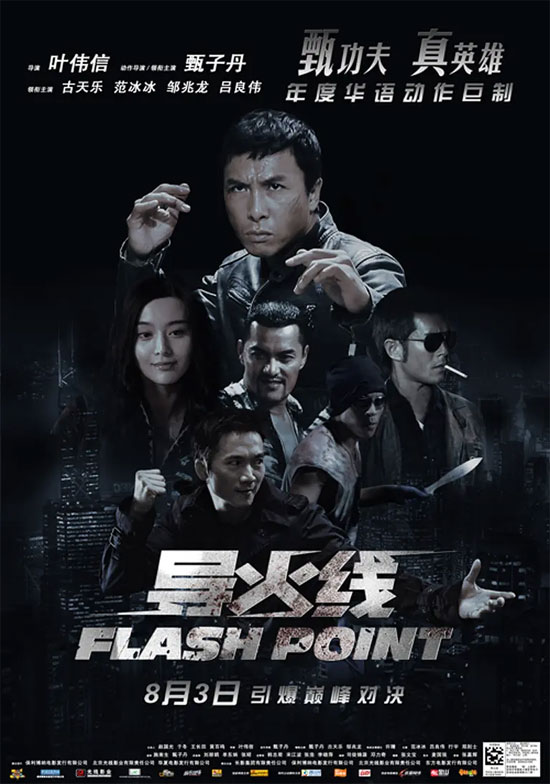
First off, let me state that this film features Donnie Yen as one of its leads. I’ve long been utterly in awe of his martial arts prowess, so my anticipation and fondness for this movie far surpasses any other film.
From its production to its theatrical release, I’ve closely followed this film for one simple reason: as mentioned, it stars Donnie Yen. For those of us born in the 80s, the star power effect has seeped into our very bones—don’t tell me you’re immune. We have our super-happy male and female idols; the gods have Cao Cao and Zhuge Liang (with Zhuge Liang recently gaining traction thanks to the “Outline of the Campaign” incident).
After returning from Hollywood, Brother Donnie has starred in numerous blockbusters in recent years. His standout performance, of course, was in the critically acclaimed “Kill Zone.” This film, “Flash Point,” lacks the cunning intrigue of “Kill Zone,” the nonstop action sequences, or the cold-blooded white-clad assassins lurking in the shadows. It carves out a completely different path. It offers a different kind of thrill—one that lets you watch the action unfold. It suits Chinese audiences, suits those who love a good spectacle, and suits the Chinese penchant for watching the drama unfold.
The opening interview sequence, featuring blatant product placements for BMW and Haier, sets a distinctly urban tone. The story unfolds before 1997, during Hong Kong’s pure British colonial era. This historical backdrop provides justification for the film’s narrative tension and certain plot elements that might seem unconventional to mainland audiences—a necessary consideration given the political context.
I’m not fond of Uncle Dan’s overly meaningful responses in the film, deliberately describing the duties of the police. Some lines might have had an unexpected effect if left for the criminals to say.
Dan’s character is an unstoppable fighter in every film he stars in. This one blends Sanda, Taekwondo, Karate, Judo, Brazilian Jiu-Jitsu, and Muay Thai—reportedly Hollywood’s current favorite approach: mixing multiple styles. As a trained martial artist, Dan masters every technique with unrestrained flair, often “rolling up his sleeves” to go all out.
Walk into the theater expecting a thought-provoking art film? Think again. Don’t anticipate the emotional pull of a romance either. This is pure commercial action—no deep philosophy, no heavy baggage. Just pure, unadulterated fun.
Enough said.
Throughout the film, it completely abandons the typical “ARPG” formula of Hong Kong action movies (nonstop fighting from start to finish, exemplified by films like Dragon Tiger Gate and Invisible Target). Instead, it efficiently establishes the characters, plot, and relationships between them early on. For the audience entering the theater, this approach builds tremendous anticipation, leaving them on edge—fearing that Dan Ge might be pulling a fast one and not planning any action today. This approach makes dialogue and scriptwriting crucial for the early scenes—an element often neglected in Hong Kong action films. Director Wilson Yip handles it masterfully, infusing wit and humor. Louis Koo serves as the film’s sole comic relief, as few actors besides Stephen Chow could convincingly make a martial arts expert like Brother Dan deliver laughs.
Blockbusters naturally feature beauties, and action epics require eye candy as embellishment. Fan Bingbing plays Louis Koo’s girlfriend—or perhaps a bartender he met at a nightclub—their relationship both direct and nuanced. “Love that can’t be stopped” captures it perfectly; at least you won’t be left wondering when this beauty suddenly appeared.
The three Vietnamese brothers deliver a formidable performance, showcasing seamless teamwork. These days, even ruthless criminals operate as professional units. The third brother handles execution with precision and efficiency, the second brother devises strategies from the shadows, commanding operations, while the eldest brother radiates overwhelming charisma and dominance, ensuring every move succeeds. They form an absolute first-rate iron triangle, an exceptionally capable entrepreneurial team.
The only missing element is detailed characterization of the Vietnamese trio. The narrative relies solely on martial arts to convey their story, which is precisely what gives Dan Ge’s action films their unique edge—conquering through combat.
The hostage rescue becomes the case’s detonator. By mid-plot, the narrative shifts into high gear—alternately thrilling audiences and gripping viewers with relentless, interlocking tension that leaves you breathless. The entire film pulls you into its chain of events like a whirlwind spectacle.
Third Brother’s failed hospital pursuit of Louis Koo, his escape, the standoff, hostage-taking, murder, rage, brutal beating, loss of reason, then sudden calm—I can only confess the sheer impact this sequence had on me. It’s nearly impossible to convey the intensity of that moment.
Once the fuse is lit, the only way to extinguish the fire is to locate its source. The film’s execution here is masterful, showcasing extraordinary editing.
The latter part of the story unabashedly launches into Brother Dan’s martial arts showdown against Tommy, the Vietnamese gang’s second-in-command and a renowned Hong Kong Muay Thai fighter. The gunfight sequences are overly technical, detailing sniper tactics and countermeasures with excessive precision (I learned enough to dominate CS now). The chase through the rice paddies is merely passable, lacking innovation. Guns clearly aren’t Dan’s forte—once he switches to hand-to-hand combat, the real spectacle begins.
From judo to Muay Thai, the fierce knees and elbows deliver intense attacks. The shaky camera creates a visceral, on-the-scene experience. The shifting battlefields equally showcase both fighters’ strengths. Dan and Tommy’s rooftop duel leaves audiences on the edge of their seats, The sheer intensity draws gasps of awe, with every punch landing with brutal impact. The Chinese immigrant’s leg techniques and lethal combat maneuvers guarantee a visual feast. (Many techniques are military-grade, designed to take down an enemy with a single strike)
Thus, I was utterly captivated by this masterpiece. Whether through its narrative or martial arts, it truly knows how to win people over.
In the end, Brother Dan sits in meditation, having long forgotten the chaotic entanglements. He has come to understand the importance of reflection and principle, sparing the criminal’s life. I might be overstating it as “great,” but to put it simply, the film subtly conveys a sense of “harmony”… haha…
Please specify:Anime Phone Cases » Flash Point 2007 Film Review: Use culture as bait, and subdue people with martial prowess.