Film Name: 每当变幻时 / Hooked On You / 每當變幻時
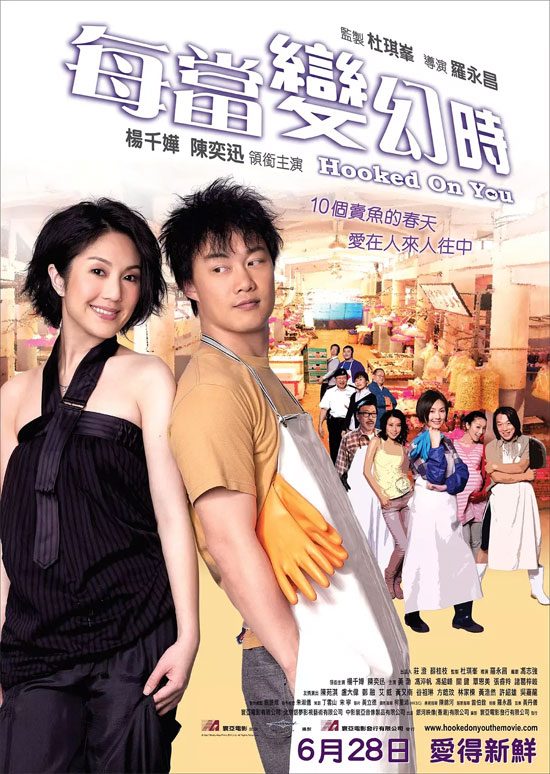
The story unfolds in Hong Kong during the late 1990s. Michelle Yeung plays Ah Miu, a young woman with lofty ambitions who is forced to make a living selling fish due to her father’s debts. Her life goal is to pay off the debt before turning 30, escape the wet market, see the wider world, and find someone worthy of her lifelong commitment. Fish Man, played by Eason Chan, initially resents Ah Miu for stealing his business, but gradually becomes moved by her almost foolish persistence. From then on, Fish Man’s life goal becomes to become a man worthy of Ah Miu’s marriage. On the eve of Ah Miu’s 30th birthday, her father dies unexpectedly, and the debt that had plagued her for over a decade vanishes with his passing. After celebrating her birthday with Fish Man, Ah Miu leaves without a word.
Years later, Ah Miu has become a moderately famous makeup artist. Hong Kong was gripped by SARS panic during this time. Amie and Fish met again amidst the chaos and fear. Just as Amie sought to rekindle their romance, Fish’s phone rang. A clear child’s voice called him “Daddy.” As they parted, Amie saw the warm, happy smiles of Fish’s family.
I adore Hong Kong-style sentimentality. It’s like taking red beans of longing, deep-fried until crispy, then pounded into a bowl of plump, unbroken copper beans. The skin is crunchy, yet inside lies a vivid, crimson sorrow. Unlike Korean idol dramas or so-called heartwarming films that insist on simmering red beans into a sticky paste that clogs your stomach.
When Ah Miu sold fish porridge on the streets late at night, Fish Man didn’t grab her hands, tears streaming down his face, declaring, “I’ll never let you suffer like this again for the rest of my life.” Instead, he kept his hands in his pockets, deliberately acting indifferent as he said, “You don’t have to work so hard,” and bought every last bowl of fish porridge. When Ah Miu’s father lay dying, he didn’t sob, “Ah Miu, I’ve failed you all my life.” Instead, gazing at the blurred figure before him, he gasped, “Ah Miu, you can finally leave the wet market…” When Ah Miu and the fishmonger reunited after years apart, she didn’t shed tears. Instead, she laughed at his flustered, chattering ramblings. Hong Kongers possess a certain carefree spirit, a playful attitude. Even the most heartbreaking emotions become fodder for laughter and banter. In Hong Kong, being “artsy” or “bourgeois” carries a negative connotation. Even Wong Kar-wai, revered by the bourgeoisie as the essential cure for art house cinema, dislikes being labeled an art film director. Hong Kongers mask deep affection with indifference and soothe loneliness with self-deprecating humor. The essence of pop culture resides entirely within the grassroots.
At the film’s conclusion, Ah Miu takes out the wallet Fish Man gave her long ago. Yet upon learning he has become a father, she hides it behind her back. Oblivious, Fish Man reaches for whatever she holds. When his hand touches the wallet and he grasps her silent plea, both fall into profound silence. Ah Miu says sadly, “Listen to me, don’t look.” After that, Yu Lao reverts to his former playboy ways. This is pure Hong Kong-style sentimentality. It simmers slowly, warming your heart bit by bit until escape becomes impossible. It’s like being tickled with long nails—initially pleasant, but eventually turning into a dull ache.
Thankfully, Ah Miu and Yu Lao never reunited. Great cinema always reflects life, not embellishes it. What’s lost is lost. Choose A, and you cannot have B. Even clothes eventually sell out—how much more so people. Human relationships can never be like the first encounter. Five years separated Ah Miao and Yu Lao in 2004. In that invisible span of time, they each experienced departure, apprenticeship, marriage, childbirth… How could the tender memories of yesterday awaken today’s feelings? As Gu Manding told Shen Shijun: “We can never go back.” Time pushes us toward aging, transforming us into who we are now. If memories faded like residual warmth beneath a blanket upon waking, I wouldn’t cling so desperately. Yet I still fantasize about happiness that never belonged to me, and I can’t resist peering into the blurred images trapped only in memory.
After Fish Man and Ah Miu said goodbye, did his heart stir? The film leaves it unspoken. We only see Ah Miu naming her beauty salon MISS
One MISS, because MISS is MISS.
When it comes to the leads, Eason Chan and Miriam Yeung, their fans always have much to say. How many wished they’d fall in love and tie the knot? But the truth is: Eason is already a father, while Miriam remains single. Both are intensely contradictory and deeply reserved individuals. Eason can play the fool in public, singing heart-wrenching ballads like “Bu Ru Bu Jian”; Miriam can portray the cheerful auntie on screen, yet deep down remains the sensitive, melancholic “Wo Deng Wo Zai.” Two such similar souls, connected by spiritual resonance, became confidants. Why couldn’t they become lovers, having understood each other so profoundly?
This is the kind of gossip I love—not the naked exposure of scandals and betrayals, but the kind that reveals 80% of the truth while keeping the remaining 20% hidden, inviting us to piece together the truth through our own subjective interpretations amidst the illusions. How utterly captivating.
I suspect A-Miao isn’t averse to ordinary happiness. She simply refuses to let her life lack vibrant hues. She merely desires that after life’s intense collisions, it gradually settles into tranquility. But that tranquility belongs solely to her—not to the person she wished to share it with.
Please specify:Anime Phone Cases » Hooked On You 2007 Film Review: Cook red beans until they turn copper-colored