Film Name: 学校风云 / School on Fire / 學校風雲
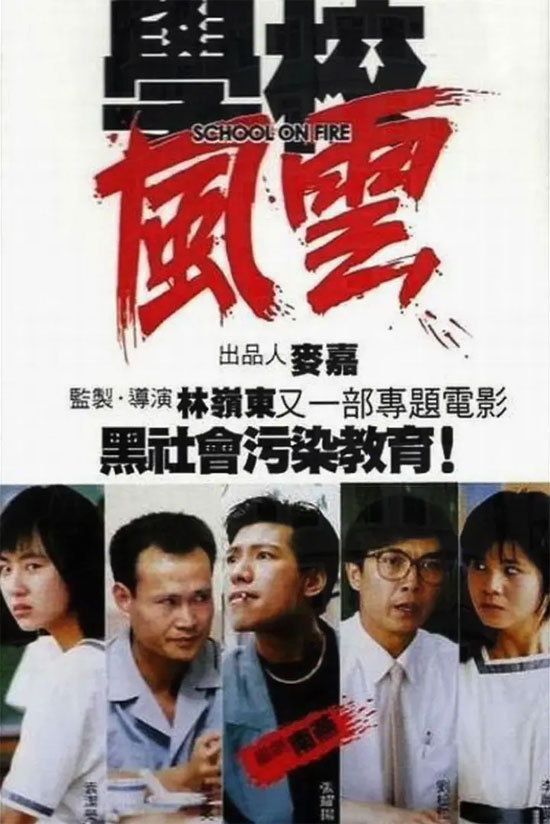
This film marks the final installment of Ringo Lam’s Triad Trilogy, though it lacks the fame of its predecessor, Prison on Fire. While prisons are notoriously treacherous places where murder lurks around every corner, who could have imagined such a tragedy unfolding within the walls of a 1988 school campus? We assume youth is painted in vivid hues, wrapped in sweet packaging. Yet some youths never let loose on windy days, never roamed under the lamp in youthful nights. Every minute, every second, they squandered their brilliance, hurtling toward ruin with utter despair.
The protagonist was Yuan Jieying. I never doubted her ability to embody this role. From her initial fragile appearance, a thread of stubbornness was already visible. She sported the most common student haircut, harboring an ambitious spirit. The innocence and beauty that should define youth shone in the light of her eyes. Yet her path led not to classrooms or books, but into a gangland catastrophe she stumbled into, never to return. At first, she passively endured what she thought were random beatings, police searches, and disco nights—all because of someone’s affection. But her most trusted friend had already dragged her into this abyss.
Seeing Xiao Zhen’s self-destruction and Wanfang’s gaze, I knew she could never go back. Nothing—not justice, not fairness—could ever match the shock of a life vanishing before your eyes.
Zhu Wanfang abandoned her family and her school. She despised every injustice, knowing she couldn’t change them, yet she couldn’t help herself. Her friend’s death had shattered her too deeply.
Later still, she ceased being passive. The very things she had abandoned failed to pull her back into her old life. She actively plunged into the abyss before her, and I nearly followed. Though such violent events never truly occurred in my own life, watching Zhu Wanfang transform from a girl with a schoolgirl hairstyle into a short-haired call girl—witnessing it all—I was nearly overwhelmed by the pain, as if I were there myself, marveling at Yuan Jieying’s performance.
In the end, they had no way out. Beyond self-destruction once more, she truly had no means to free herself…
The film’s true value lies not only in its profound portrayal of the cruelty and damage inflicted by school violence, but also in its vivid depiction of the myriad facets of urban life—
“We catch the culprit, but you refuse to identify them. Then you turn around and accuse us cops of not doing our job.” This relentless cycle of retaliation silences every witness. It’s not that the police are inactive, but the vicious loop involving triads, ordinary citizens, and law enforcement is impossible to break. The police suffer, the witnesses suffer, and in the end, it’s the justice system that bears the brunt of the damage.
What fairness? They’re so rich while we’re so poor—what fairness is there in this world? The film dedicates numerous shots to Kowloon Walled City, then a den of all manner of unsavory elements. Towering yet cramped low-rise buildings fill the frame. Those struggling at the very bottom lived here, some never having left their entire lives. Violence, obscenity, and drug trafficking ran rampant here—a veritable haven for organized crime. A government that did nothing, a police force powerless to act, and gangsters running amok—fairness? What fairness?
“Sir, you think you’re really the one with the gun? You call the shots at school, but out here, I’m the boss! The school’s academic atmosphere is chaotic. Parents only care that their children stay enrolled—learning is secondary. When trouble arises, they blame the teachers. Even when problem students deliberately cause disruption, nothing can be done. Witnessing students sink into despair, the teachers are utterly powerless! The exemplary teacher portrayed by Lau Chung-yan embodies this helplessness and heartache.
“You teachers, when have you ever stood up for me? All you do is pamper those good students!” Copy that sentence a thousand times and hand it in tomorrow!” On one side are the unruly students; on the other, the opportunistic teachers. When the scales of education tilt, when professional ethics are disregarded, the self-serving opportunists represented by the female teacher in the film indirectly push students to the brink. This reflects the harsh realities within the education sector, provoking deep reflection…
In short, this film surpasses Ringo Lam’s earlier work “Prison on Fire” in quality, with smoother pacing, greater depth, and a broader scope expanding from campus to society. It portrays diverse groups including triads, persecuted citizens, the underprivileged, teachers with conflicting attitudes, police, and the victims of school violence whose suffering culminates in tragedy. Regrettably, without Chow Yun-fat in the lead role, the film’s impact and box office performance fell short of expectations. Nevertheless, it stands as the defining performance for Yuen Kit-ying, who had previously been typecast as the good girl or mischievous student. She authentically portrayed the psychological journey of a girl driven to the edge, delivering an unforgettable performance.
It’s heartbreaking that the issues depicted in the film still persist today. Behind every tragedy, countless young lives plunge into the abyss—a reality we can never fully grasp… In the movie, Zhu Wanfang’s indignant rebuttal to her teacher, followed by her solitary walk down that dark corridor, seems to foreshadow the inevitable destruction of that stubborn youth.
Please specify:Anime Phone Cases » School on Fire 1988 Film Review: A youth destroyed, a life torn apart.