Film Name: 男儿本色 / Invisible Target / 男兒本色
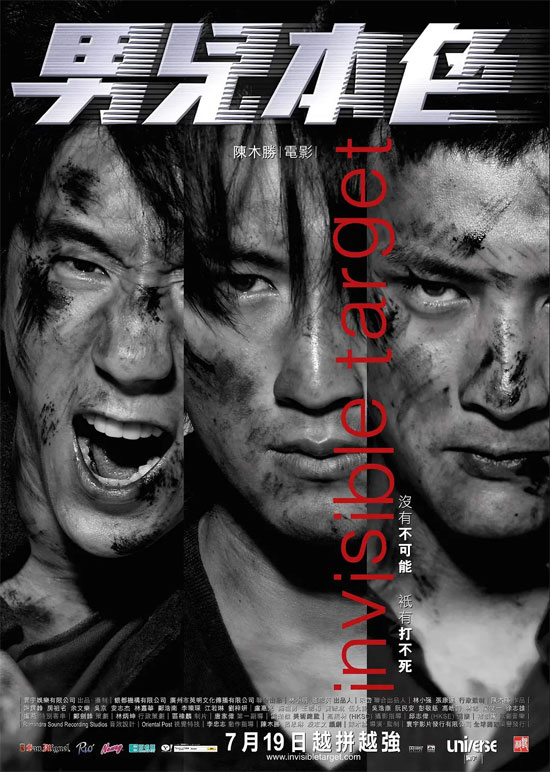
I’ve always believed that Peter Chan is the kind of Hong Kong director who would thrive in Hollywood. His command of large-scale scenes and mastery of cinematography exude a blockbuster style, evident in films like “Who Am I” and “New Police Story.” “Invisible Target” is another action-packed cop thriller packed with grand sequences, making it a highly anticipated release.
Starring a cast of young actors including Nicholas Tse, Shawn Yue, Wu Jing, and Jaycee Chan, this film tells a story of male vengeance. The plot unfolds from an armored car robbery. A gang led by Wu Jing accidentally harms Nicholas Tse’s fiancée during the heist, while Jaycee Chan’s brother is killed by the robbers due to his undercover role. Thus, both officers are driven by vengeance. As for Wu Jing, though a robber himself, he was betrayed—losing not only the money but also three brothers. His quest for revenge carries an added layer of righteous retribution, setting the stage for the unfolding story.
Director Alan Mak’s opening sequence carries a distinctly Hollywood flair: a serene, picturesque street where a young woman purchases her wedding ring. Everything appears harmonious and peaceful until a sudden robbery shatters the tranquility—a classic setup in Hollywood crime thrillers that undoubtedly plants seeds for the narrative to come. Six months later, the story truly begins.
Rayne’s quest for vengeance carries comedic undertones. Though a fearless cop, he encounters Wu Jing and his crew by chance and suffers a humiliating defeat. Driven both by his duty to apprehend criminals and his desire to restore his lost dignity, he joins the pursuit of Wu Jing. Two cops driven by vengeance and a traffic officer seeking justice for his brother now confront Wu Jing’s gang head-on.
Although the betrayal of the robbers provides an excellent narrative hook, the film clearly avoids the suspense route. Instead, it places the confrontation between police and criminals front and center from the outset, treating the mastermind behind the scenes merely as a plot thread to be gradually unraveled by Wu Jing. Undoubtedly, the clash between soldiers and thieves is the film’s focal point. While Peter Chan typically relies on large-scale, gun-heavy conflicts to establish this tension, this film shifts the emphasis to martial arts. In recent Hong Kong action cinema, the success of Donnie Yen has brought back the gritty, bone-crunching physicality of hand-to-hand combat. The fight sequences here largely follow this design. Compared to the Jackie Chan films directed by Ringo Chan, the action here has less humor and fewer high-difficulty stunts, retaining only the sheer intensity of life-or-death combat. This kind of intensity holds immense explosive power and tension for any male audience, making danger one of the film’s major draws.
Throughout the film, police and robbers remain inextricably entangled, leading to frequent confrontations. The formidable strength of the robbers (Wu Jing, Andy On) keeps the police largely at a disadvantage. This willingness to charge into danger despite the risks seems to embody the very essence of masculine fervor. Of course, as mentioned earlier, each character has compelling reasons to risk their lives. Consequently, the film flows smoothly, and the characters’ motivations never feel jarring to the audience. It’s a remarkably pure and direct film. Whether it’s the characters’ personalities and psychological motivations, or the design of the fight sequences and the execution of various dangerous stunts, it delivers a direct impact to the audience. For such a film, one cannot demand excessive depth; instead, the viewing experience is entirely focused on these direct elements. Fortunately, the writer was not disappointed. The explosive scenes created by fists during the fight sequences deliver a satisfying thrill, while the shots of flesh colliding with solid objects evoke a palpable sense of heart-pounding intensity. The impact of close-ups, the interplay of fast and slow editing, and the multi-angle repetition of dangerous stunts—all these techniques, under the direction of Rayson Chan, pulsed with such rhythm that they practically transported the audience into the action. Thus, within this immersive experience, we witness a blood-soaked feast of masculine combat.
Commercial crime thrillers offer visual gratification, a consensus among most viewers. Yet as special effects dominate our audiovisual experience and terms like “flashy” become overused, our enjoyment seems to suffer from aesthetic fatigue. Thus, Hong Kong filmmakers have once again pioneered a reinvention of martial arts cinema ahead of Hollywood. I believe that, at least for the foreseeable future, visually impactful films like this one—feeling intimate, authentic, and direct—will be immensely popular, never leaving audiences disappointed or jaded. Admittedly, the film’s excessive focus on combat sequences results in underdeveloped characters and a plot that’s simplistic, formulaic, and occasionally drawn-out. Yet, as a commercial film whose primary purpose is to deliver a feast of action, it remains thoroughly recommendable!
Please specify:Anime Phone Cases » Invisible Target 2007 Film Review: Punching with real force is definitely more impressive than striking poses.