Film Name: 火烧岛 / Island of Fire / Island On Fire / Fire Burn Island / The Prisoner / The Burning Island / When Dragons Meet / 火燒島
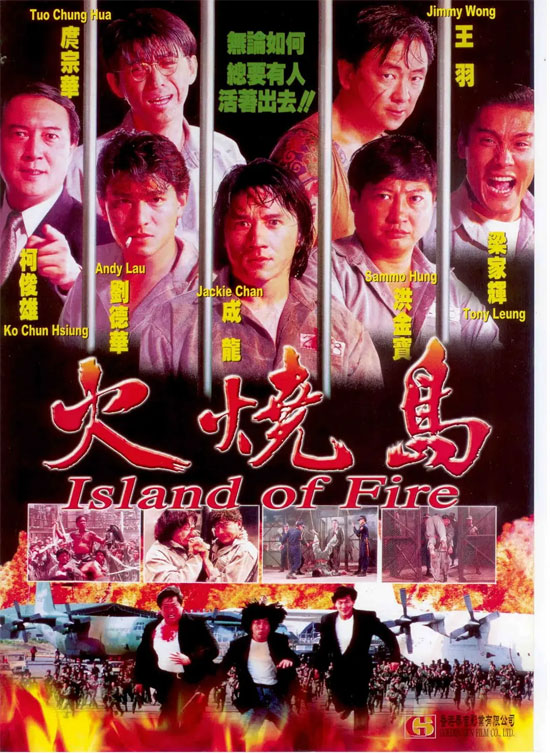
The 1991 Taiwanese film “Island of Fire” is not an outstanding work, but its “all-star cast” continues to be a topic of discussion among many film fans to this day.
The star power of “Island of Fire” rivals that of “Infernal Affairs 3: End Inferno” (2003). While “Infernal Affairs 3” is famously credited with featuring “five major film emperors,” this film also boasts its own “five major film emperors”: Jackie Chan, Andy Lau, Tony Leung Ka-fai, Sammo Hung, and Ko Chun-hung. The weight of these “Five Leading Actors” is no less than that of “Infernal Affairs 3”. Beyond the “Five Leading Actors”, “Island of Fire” also features heavyweights from the Hong Kong and Taiwan film scenes of the time, such as Wang Yu, Tong Zonghua, Gao Jie, and Ye Quanzhen.
However, having too many leading actors also presents challenges, demanding careful scene allocation from the director. Among the five, Jackie Chan commanded the greatest influence and star power at the time, yet his screen time was relatively limited compared to Tony Leung and Sammo Hung. Director Chu Yuen-ping revealed that Chan only allocated four or five working days for filming. Shooting so much material in just four or five days was an overwhelming workload for both Jackie Chan and director Chu Yuen-ping. While the limited screen time made sense given the schedule, the sheer volume of work far exceeded what was reasonable. Chu Yuen-ping is a shrewd director who understands Jackie Chan’s busy schedule and high fees. He always secures Chan for the shortest possible shoot while maximizing the footage captured. This tactic was already employed in 1982’s “Mini Force,” where Chan wasn’t the lead actor but was used as the biggest “selling point.” By casting Jackie in “Island of Fire,” Chu essentially replicated the same strategy employed nearly a decade prior, maximizing the star’s commercial value. It’s fair to say that the distribution of screen time in “Island of Fire” wasn’t about who was the biggest star, but rather whether the multiple award-winning actors could coordinate their schedules.
Chu Yan-ping is arguably Taiwan’s No. 1 commercial film director. Unlike Hou Hsiao-hsien, Yang Dechang, and others who painstakingly cultivated art films, Chu rarely discusses artistry, focusing solely on commercial cinema—a pursuit he takes pride in. He once criticized Hou and Yang, arguing their films dragged down Taiwan’s film industry. Chu has reason to be proud: while Taiwanese directors collectively neglected the local film industry, he steadfastly produced commercial films to sustain it. Zhu Yanping has directed roughly 100 films, all commercial productions, though many remain obscure. These lesser-known works weren’t necessarily “money-losers”; rather, factors like subject matter and distribution channels kept them from entering the mainstream spotlight. Put simply, Zhu has made numerous low-budget B-movies that enjoy a surprisingly robust “hidden market,” though this remains largely unrecognized. Of course, Chu also produced a substantial number of mainstream entertainment films, including notable works like the “Shaolin Popeye” series (1994), “Grandpa’s Love” (1994), and “China Dragon” (1995). It’s fair to say Chu isn’t a director of exceptional artistic vision; he’s more of a film craftsman. However, he is content with his role and diligently excels as such. Thus, in a certain sense, Zhu Yanping is a good director—one who delivers for his producers, satisfies his audience, and remains true to himself.
Zhu directed one poignant work, End of the Road (1990), depicting the plight of defeated Nationalist soldiers stranded in a foreign land. Though not technically polished, the film remarkably captures the “tragic pathos” of the Nationalist Army trapped at their “dead end,” marking the most heartfelt work of Chu’s career. It’s said he secured this project by agreeing to direct a ‘blockbuster’ (a sequel to “Big-Headed Recruit”?) for a “gangster boss.” Nevertheless, “End of the Road” achieved massive commercial success, outperforming the blockbuster he had promised to make for the “underworld boss.” This marked an “exception” in the career of Taiwan’s premier commercial filmmaker, Zhu Yanping—though not entirely so. He simply poured his heart into crafting a visceral, flesh-and-blood commercial blockbuster.
The producer of “Island of Fire” is Taiwanese veteran actor Ko Chun-hsiung, while the executive producer is Wang Yu, who starred in “The One-Armed Swordsman” (1967). Both actors also took on leading roles in the film with great enthusiasm, suggesting these two veteran stars intended to collaborate on creating an all-star “blockbuster.” With such a formidable production team, “Island of Fire” had the potential to become a classic. However, Zhu Yanping failed to seize the opportunity or dedicate himself to refining the film, resulting in a work that merely possesses the outward trappings of a “blockbuster.” It can be said that “Island of Fire” was both Zhu Yanping’s triumph and his downfall. Zhu Yanping possessed the ability to assemble such a star-studded cast and coordinate their schedules, yet he functioned merely as an adept “coordinator.” He failed to leverage these resources to pursue greater creative heights. Despite boasting the finest lineup, “Island of Fire” seemed driven primarily by box office ambitions. Zhu Yanping showed insufficient dedication to refining the script or meticulous on-set direction, ultimately delivering a hastily assembled work.
When the theme song of “Island of Fire” began playing, I knew instantly it was Cui Jian. Cui Jian rarely lends his voice to films; aside from this one, I’ve only seen him contribute to two others: “Beijing Bastards” (1993) and “Roots and Branches” (2001). His self-directed “Blue Sky Bones” (2013) is a separate matter. It doesn’t surprise me that Cui Jian contributed to “Roots and Branches” and “Beijing Bastards,” but his involvement in a “commercial blockbuster” was genuinely unexpected. The theme song he performs in the film is titled “Zui Hou Yi Qiang.” Did Cui Jian record this song first, and then Zhu Yanping selected it as the theme? If so, my surprise would be somewhat lessened. However, even if “Zui Hou Yi Qiang” was written specifically for “Island of Fire,” I don’t view it as a negative development. I believe the involvement of “serious” artists in commercial films can be beneficial, potentially elevating the artistic quality of such productions.
Please specify:Anime Phone Cases » Island of Fire 1991 Film Review: The Success and Failure of “All-Star Blockbusters”