Film Name: 美猴王 / The Monkey King
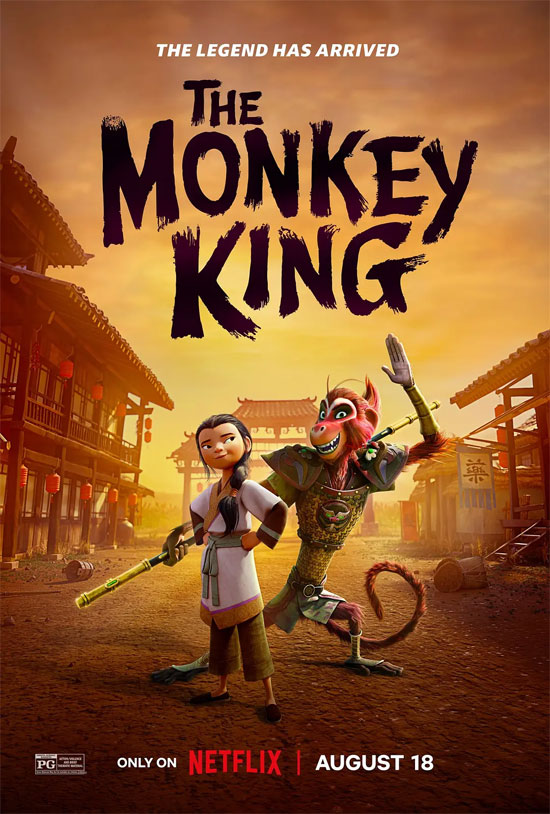
Produced by Stephen Chow, “The Monkey King” is now streaming on Netflix. This marks yet another Western adaptation of a classic Chinese literary masterpiece. In my view, this film can only be considered a work that borrows heavily from Journey to the West, yet its themes, character dynamics, and other elements bear no connection whatsoever to the original novel. For instance, we see the Water Curtain Cave in the Peach Blossom Spring, the Peach Garden, the Five Finger Mountain, the Red Boy, King Yama, Sun Wukong stealing the Golden Monkey Staff from the Dragon King, the Jade Emperor and Queen Mother of the West in Heaven, and the Buddha Sakyamuni. The abundance of familiar Chinese names, terms, characters, and settings makes the film feel strikingly close to us. Yet when we see the Golden Monkey Staff glowing like the iconic lightsabers from Star Wars, when the Dragon King transforms into a pig-like demon intent on wreaking havoc, when the Buddha appears to tower over the Celestial Palace, even striking fear into the Jade Emperor, when Tang Sanzang finds Sun Wukong already accompanied by Zhu Bajie and Sha Wujing, and when the young girl Lin and Sun Wukong engage in psychological mutual guidance— mirroring the formulaic character growth narratives of Hollywood animated blockbusters, we sense that everything here feels so disjointed. This film, in truth, feels distant from us, distant from Chinese culture. The film’s innovation lies primarily in two aspects. First is the introduction of a young girl named Lin. Much like Jiang Liu’er in Monkey King: Hero Is Back, she serves both as a protected figure and as a guide for Sun Wukong’s psychological growth. Pairing a powerful, rebellious figure with a friend and companion—a sheath for the sword, imposing moral constraints—is a classic narrative trope. Yet in this film, the emotional development between Lin and Sun Wukong feels underdeveloped. Crucially, Lin does not sacrifice herself in the crisis like Jiang Liu’er does, making Sun Wukong’s psychological growth seem somewhat contrived and failing to deeply move the audience. Second, the character designs are remarkably innovative. Audiences accustomed to the conventionally attractive faces in Chinese-style animation might find this Sun Wukong rather ugly. The Queen Mother of the West and the Jade Emperor also aren’t conventionally beautiful. In truth, character design prioritizes conveying personality and emotion over mere aesthetics. Compared to conventionally attractive faces, I prefer the deliberately rough design of Sun Wukong in this film, as it allows the audience’s focus to center more intently on his inner world. Lin, too, is not a typical beauty, yet she embodies an ordinary and unassuming quality that makes it easier for viewers to project their emotions onto her, revealing a truly beautiful heart. Finally, I want to say: the West never intended to portray the authentic Journey to the West. They merely use it—alongside classics and traditions from countries and regions worldwide—as an entry point to express their own values. Of course, we cannot demand others faithfully reproduce our culture. We can only hope for our own continuous growth, striving to truly promote and enrich our cultural heritage.
Please specify:Anime Phone Cases » The Monkey King 2023 Animation Film Review: This Monkey King is very Western.