Film Name: 雄狮少年 / I Am What I Am
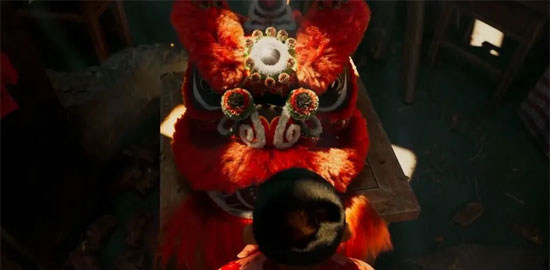
When the male protagonist, A Juan, cuts off his long hair, transforming from a sickly cat into a rugged young man, then lifts the red lion head—as if it had been waiting for passion and exuberant energy to be poured into it—and begins to dance with agile and carefree movements, I feel this might be the most romantic and moving scene for a man.
Lion dance is a love letter written to Chinese men. Its sender is China’s outstanding traditional culture, and its recipients are every young man passionate about lion dance. The animated film “I Am What I Am” delivers this love letter through a fresh and innovative service. This delivery is sure to resonate with millions of new recipients.
The film deliberately portrays its male protagonist as a “sickly cat” at the outset, easily evoking associations with China’s historical label as the “sick man of East Asia.” It was through the Chinese nation’s spirit of fearless courage, indomitable will, willingness to sacrifice, and even embrace of death that a new nation and a new life of happiness were forged. The tiny lion heads, the repeated surges of inner passion, the shouts and roars, the dances that challenge oneself and scale new heights—are these not subtle reflections of that very spirit and will?
Thus, the film’s greatest real-world value lies in awakening the lion spirit that should reside within every Chinese man. No effeminate posturing, no idolizing of “pretty boys”—what we need are true men who, like lions, give their all, challenge the ultimate, and let their lives bloom. What is true beauty? It is Ajuan’s final, selfless leap.
The film’s most ingenious device lies in the male protagonist’s ultimate challenge: not defeating other lion dancers, but confronting his own courage, strength, and limits. When Ajuan stomped the ground with his injured foot and soared skyward, time seemed to freeze, breaths halted, and the world froze in place. It was a long-forgotten, resonant sensation.
This time, traditional culture finally emerges not through a mythical world filled with violence and combat, but through a realistic world steeped in everyday life. This represents a significant thematic breakthrough in recent domestic animated films, reminding us that realistic subjects can also craft compelling stories, move hearts, and generate immense market value.
From traditional culture + mythology to traditional culture + reality, this breakthrough carries a deeper significance: it shifts the audience’s attraction from the shell of traditional culture to its true essence. No longer relying on the dazzling fantasy of mythical metaverses or the spectacular grandeur of battle scenes to captivate, it instead moves viewers through the profound truth embodied by lion dancing and the spirit of its cultural heritage. It no longer fixates on crafting rebellious personalities detached from life’s constraints, embodying the “my destiny is in my own hands, not heaven’s.” Instead, it focuses on creating visible, tangible, and down-to-earth real emotions. When audiences realize through the film that lion dancers don’t necessarily have to look as cool and handsome as Ao Bing, but they truly look cool and handsome when they dance the lion, that’s when the love sparked by this love letter truly hits the mark.
Of course, creating realistic animated films is no easy feat. While we commend the groundbreaking efforts of “I Am What I Am,” we must also acknowledge that our lack of prior experience in this genre led the film into some pitfalls. It took a few detours, sacrificed some brilliance, and resorted to some simplifications.
For instance, the film strives to portray a sense of harsh reality. Ajuan faces bullying and robbery while trying to learn lion dancing, and encounters constant harassment while delivering food for money. Though Ajuan’s father works as a migrant laborer to support the family, many lines in the film reflect a certain bias against this group. As a minor, Ah Juan must even leave home to work and support her family. Construction sites actually employ child laborers like her, where she isn’t even allowed to sleep in a bed but must rest on the floor beneath others’ beds—referred to in the film as the “lower bunk.” While watching, I found myself wondering: Is this truly our society?

Does our society really harbor the realities depicted in this film? Perhaps it does. But is our society defined solely by such harsh realities? Or do such brutalities dominate the mainstream? Certainly not. The film selectively emphasizes the cruelty of reality while overlooking the abundant compassion and support that also exist—this is a distortion of reality.
Ah Juan dreams of becoming a lion-dancing youth. Our society should actively create opportunities for him to pursue this dream. Whether he ultimately achieves it depends on his personal talent and effort. The challenges he faces should be: hesitating to perform moves, struggling to find partners or a teacher, failing to grasp the essence of the art, encountering formidable opponents—things like that. Our society shouldn’t become an obstacle to his dream. The difficulties he encounters shouldn’t be: facing bullying and suppression, enduring cold stares and discrimination, or being forced to work for survival, leaving him no time or energy for what he truly wants to do. Thus, the film falls into a misconception by using the positive energy of a few individuals like Ah Juan and Xian Yu Qiang to counteract societal negativity. The correct approach should be the reverse: harnessing societal positive energy to counteract the negativity of a few individuals.
The notion of “taking a detour” implies that Ah Juan’s family circumstances bear no direct relation to his mastery of lion dancing. The film’s extensive focus on his family feels like grasping at straws. Xian Yuqiang’s experiences as Ah Juan’s mentor are what directly connect to lion dancing. For instance, why did Xian Yuqiang stop dancing? What injuries or illnesses did he suffer? What psychological scars did he carry? And how did meeting Ah Juan help him rediscover his lion dancing dreams? The film should have devoted more attention to these elements, which better reveal the essence, culture, and value of lion dancing.

To avoid this detour, I believe Ajuan’s father and his master could be merged into a single character. Later, when Ajuan recalls his father encouraging him to watch lion dances as a child, that moment becomes the origin of his lion dance dream. His father could easily be portrayed as a once-great lion dancer who stopped performing for some reason. Having the father serve as the master, with the son inheriting his father’s craft, is perfectly natural and logical. There’s really no need to introduce another master character.
The lack of brilliance lies in the fact that animated works with realistic themes differ from live-action dramas of the same genre, which demand pure realism. Animation is fundamentally an art form defined by imagination. Even when depicting reality, it must be expressed through imaginative rhetoric. For instance, Hayao Miyazaki’s imaginative depiction of fighter planes in “The Wind Rises,” or “Little Chef” capturing the blissful feelings of diners savoring delicious food through imaginative portrayal. The Chinese animated film “Kiangnan 1894,” though centered on pre-liberation national heavy industry, also begins with an imaginative sequence where the male protagonist pilots a self-built plane into battle within a dream.

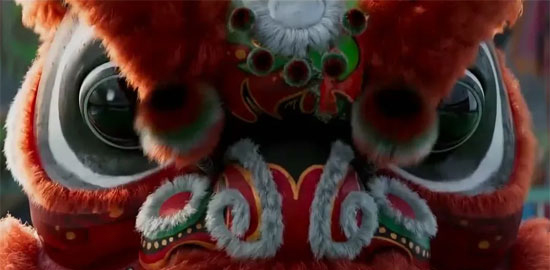
Ah Juan’s encounters with the lion dance certainly extend beyond reality into his imaginary world—in dreams, when he feels like giving up, and so on. Within this imaginative realm, the small lion head transforms into a cartoon-like mighty lion, enabling a more intimate connection with Ah Juan. Audiences encountering such imaginative depictions may smile knowingly, choosing to believe it as truth. This personification and animation of the lion dance significantly helps the tradition take root in viewers’ hearts, fostering a desire for ongoing engagement.
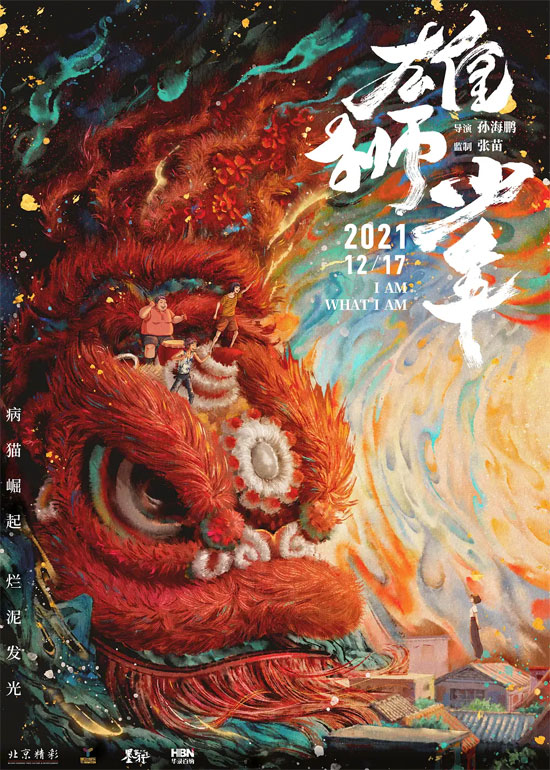
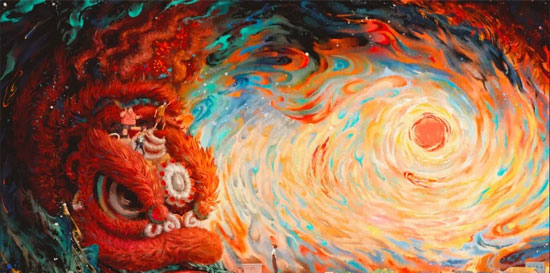
In fact, the film features a strikingly colorful and eye-catching poster. On it, the lion becomes enormous, with three youths standing atop its head gazing into the distance. Joking aside, I feel the imaginative power contained in this poster seems richer than that distilled throughout the entire film. The imagery of this poster could even be directly incorporated into the work itself, becoming a sequence brimming with imagination.
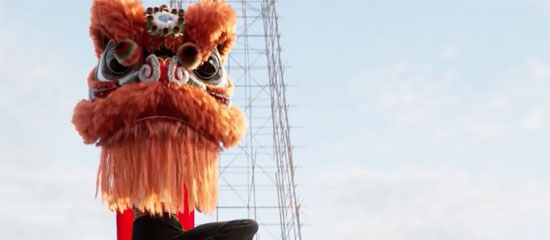
I particularly want to emphasize that the lion head should not be a lifeless object, but one with a soul. Animation can be used to humanize and creatively express this. If the film can successfully blend its realistic subject matter with the imaginative power of animation, it will add that extra spark of brilliance. And this new brilliance could very well be the crowning touch for the lion dance.
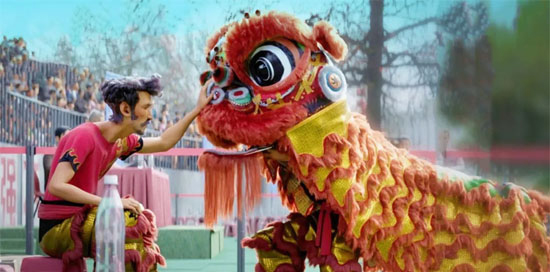
The film’s decision to avoid idealized character designs actually contributes to its sense of realism. This aligns with the story’s core theme: anyone can become their own lion dancer. As long as that spark of passion remains alive within them, they can keep moving the lion’s head, challenging themselves.
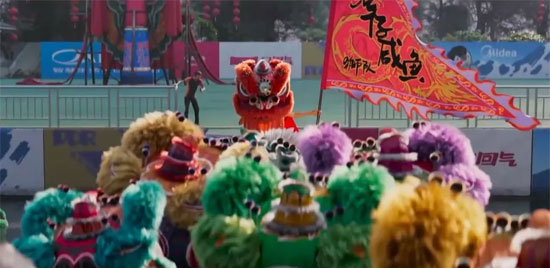
However, the film simplifies the characters’ growth arc. A team of three teenagers with zero lion-dancing experience somehow becomes the local champion after just a few months of training, defeating numerous teams with years of practice—some even professionally trained. This feels implausible and doesn’t hold up to scrutiny. After all, lion dancing is an intangible cultural heritage whose mastery demands years of dedication; success doesn’t come easily. Much like acrobatics, it demands years of foundational training; achievements rarely come overnight. Ajuan is an ordinary person—neither born into a lion dance family nor blessed with extraordinary talent. The film offers no convincing explanation for how her dreams alone could overcome the accumulated hard work of others.
The character of Xian Yuqiang, Ah Juan’s master, stands out as a brilliant supporting role with his own distinct narrative and emotional arc. Though the relationship between his wife and him receives limited screen time, it masterfully blends humor and pathos, significantly enriching the film’s emotional depth.
Another noteworthy moment occurs when Ah Juan’s former rival ultimately acknowledges her through her self-challenge, and the scene where many competitors cheer for Ah Juan together is deeply moving. This emotion stems from how it elevates the meaning of lion dancing beyond mere competitive ambition. What truly drives people to engage in lion dancing isn’t the championship title, but the spiritual strength it bestows. The spirit embodied by Ah Juan resonates with everyone present—and with the audience.
Conversely, the supporting characters in the film remain relatively flat, including even the two youths paired with Ajuan. Their character arcs lack clarity, with little discernible development from beginning to end. Overall, while the film handles emotional moments with some brilliance, it still adheres to a common trait of domestic animation: action sequences often overshadow the dramatic ones.
Finally, the film’s music left a profound impression on me. This is a quintessential example of a work where outstanding music elevates the entire atmosphere. If the film succeeds, the music deserves half the credit. Since the film primarily depicts southern lion dancing, especially Guangzhou-style lion dancing, many songs are performed in Cantonese. This choice enhances the rich regional flavor, creating a harmonious fusion of sound and image that is both engaging and delightful.
Please specify:Anime Phone Cases » I Am What I Am 2021 Animation Film Review: Lion Dance is a love letter to the sons of China.