Film Name: 老鹰抓小鸡 / Goldbeak / Eagles and Chickens: Goldbeak
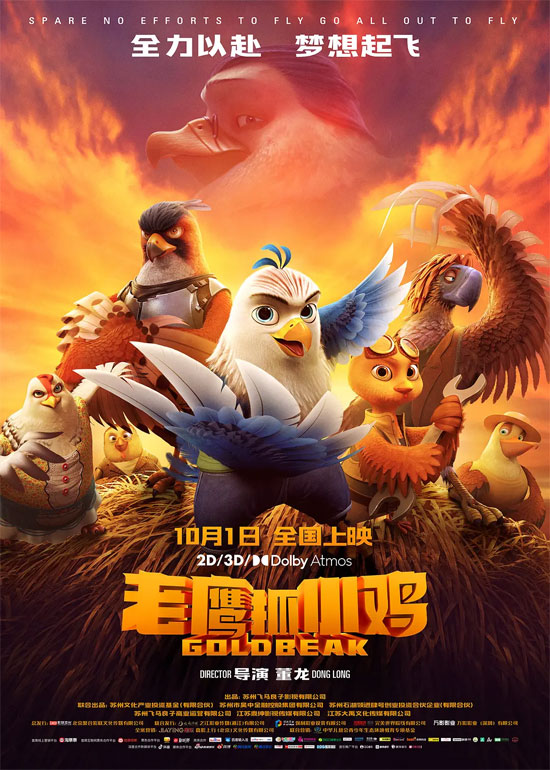
Two years ago, I first saw the trailer for “Eagles and Chickens: Goldbeak” at the Nanjing Animation Investment Conference, and it left me quite impressed. Ever since, I’ve been eagerly anticipating the film’s release. Yet after watching the full film in theaters today, I found myself overcome by a complex mix of emotions. While the creative team’s dedication is evident, their creative limitations are equally apparent. This weakness isn’t unique to this film—it’s a common pitfall many young Chinese animation teams have stumbled into, paying their dues along the way.
This is a classic case of prioritizing details over the whole. Imagine a massive sculpture: no matter how intricate the carving on individual sections, without a cohesive overall vision, it remains a beautifully distorted piece. For “Eagles and Chickens: Goldbeak,” no matter how meticulously crafted the feathers appear, they remain isolated details. What truly matters are two core elements: Goldbeak’s journey as an eagle and the dynamic between eagles and chickens.
First, let’s examine Goldbeak’s growth. His journey unfolds in four distinct phases.
Phase One: Leaving Chicken Village. This fundamentally involves learning independence.
Phase Two: Mastering flight under the guidance of the reclusive master. This pivotal step serves dual purposes: flight becomes Goldbeak’s professional skill, and soaring through the skies fulfills his childhood dream while cementing his identity as an eagle.
The third step is integrating into Bird City. After all, Jinbao isn’t a lone wolf; he needs to join a community or team, using his skills to realize his life’s purpose. Here, he must hone his mind and refine his abilities.
The fourth step is saving Chicken Village. This can be seen as Jinbao’s “rite of passage,” where he fulfills his coming-of-age ceremony by repaying the kindness he received. Ultimately, he must learn for whom he flies.
While the film broadly depicts these four stages, its emphasis on each differs significantly.
In the first stage, the film portrays a Chicken Village rife with selfishness, hostility, and exclusionary attitudes—a stark contrast to the caring community it should have depicted. If I were Jinbao, I’d sing “Only Mom Is Good in This World,” because truly, only his mother is kind to him. He never experiences the warmth of a chicken village family; instead, he faces constant scorn and cold stares. Is such a chicken village truly worth his longing and saving? His independence should stem from a spontaneous desire to break free from sheltered warmth, not from being forced into exile.
This touches on another common issue in domestic animation: the tendency to drive plot through negative emotions. The segment in Chicken Village is saturated with negativity—the children ostracize him, other parents offer cold remarks, and Jinbao and his mother are frequently subjected to public criticism in front of the entire village. Can a child’s psyche remain healthy in such an environment? The so-called “negative emotion-driven plot” means presenting these flawed approaches first, only to prove them wrong later, implying they should not be followed. When depicting children, we should instead cultivate positive emotional guidance—presenting the correct approach and ultimately demonstrating its validity. We need to build a loving Chicken Village where neighbors respect and support each other, where children form pure friendships transcending boundaries, and where these bonds ultimately have profoundly positive effects on Jinbao.
In the second step, the film aims to depict Jinbao’s pivotal first flight scene, but it clearly lacks weight and plausibility. An eagle raised by chickens, much like a wolf raised by dogs, loses some of its wild instincts. A more plausible setup might be that Jinbao initially lacks the motivation to fly—reluctant and afraid—yet harbors an inner calling urging him to soar. When “The Hero” pushes him off the cliff to teach him flight, his instincts respond to this inner yearning. As he finally bravely flaps his now-powerful wings, he gains a new perspective and height from which to view the world.
The film should also depict more details of how the “Hero” taught him to fly. For instance, how to fly with the wind, against the wind, ascend, dive, circle, and land. These details would enhance the realism of flight while deepening Jinbao’s bond with his mentor, laying groundwork for later plot developments. In short, the learning-to-fly sequence should be as detailed as possible. Yet the film merely skims over Jinbao’s practice scenes of catching prey before abruptly letting him enjoy the breathtaking vistas of high altitudes.
In the third step, the film focuses on Jinbao’s story with “Gai,” another elite disciple from the eagle squadron. His other social development almost exclusively involves conversations with his uncle. This feels somewhat monotonous. During this mental growth process, Jinbao should encounter more people and experiences, not just one or two individuals and events. Much like Kiki, the young witch who arrives in the big city from the countryside in Kiki’s Delivery Service, he needs to encounter a diverse array of people through his work. Only then can he continually learn about human nature, gain wisdom, and discern right from wrong.
In the competition with Guy, the film depicts a scene where Jinbao dives down from a skyscraper. This idea is good, allowing Jinbao to put past grievances aside and prioritize friendship over competition. However, having Jinbao complete the high-altitude dive early feels somewhat wasted. If the film had designed Jinbao to struggle with the psychological barrier and technical challenges of the dive until the climactic rescue of Chicken Village—where he finally unleashes his full potential to save the falling villagers—it would have created far greater dramatic tension.
In the fourth step, the film presents Jinbao’s showdown with his uncle as a “rite of passage.” The uncle’s rotund physique starkly contrasts with Jinbao’s father Yinying’s naturally aerodynamic, towering stature—making him an unconvincing opponent for a flying duel. Here, the uncle should have been given a “hidden assassin” role—a killer who may have ultimately murdered Silver Wing. This assassin must possess exceptional flying skills, truly top-tier. Only by overcoming himself and defeating this ultimate killer could Jinbao prove he had truly completed his graduation ceremony in flight, even surpassing his father. As for the pampered uncle, leaving him to Gao would suffice.
The film unfolds in this manner—each step seems accounted for, yet the core message each should convey and the essential plot devices required remain unclear. This ambiguity results in a viewing experience lacking cohesion and unity.
Now, regarding the relationship between eagles and chickens.
The film shares many parallels with Disney’s animated feature “Zootopia.” While “Zootopia” features mammals as its inhabitants, “Eagles and Chickens: Goldbeak” depicts an entirely avian world. Both films follow protagonists transitioning from rural to urban settings. Bird City and Zootopia are both tech-infused “utopian” worlds that appear dazzlingly perfect on the surface, yet harbor dirty dealings and hidden conspiracies.
We observe that in “Zootopia,” all animals are equal—tigers and mice differ only in occupation, not in rights. Yet in “Eagles and Chickens: Goldbeak,” birds are unequal. Eagles reign supreme, holding positions like mayor and acting with impunity. Chickens, however, are forced to live in subservience, confined to remote corners. Particularly egregious is the eagles’ innate sense of superiority, viewing chickens as an inferior species—an utterly irrational notion. “Fly high and see smiling faces; fly low and see butts.” While the film may intend this line as inspirational, it leaves me with a fishbone stuck in my throat—that bone being racial discrimination.
While this film also builds its character dynamics around the predator-prey relationship between eagles and chickens, its key difference from the wolf-sheep conflict in “Pleasant Goat and Big Big Wolf” is this: in the latter, Happy Lamb and Big Big Wolf are natural enemies—the wolf seeks to eat the sheep—but the wolf doesn’t view the sheep as inferior. In “Eagles and Chickens: Goldbeak,” the eagle may not necessarily intend to devour the chickens, yet it views them as an inferior race—a form of racial hierarchy that categorizes beings into rigidly defined classes. That such ideology is embedded within a family-friendly animated film—and remains unchallenged by the narrative, with no character delivering a resounding call to recognize eagles and chickens as equal beings—is deeply troubling.
The contrast between Bird City and Chicken Village is actually a profoundly layered concept. Bird City towers above, its skyline densely packed with towering structures. Chicken Village is flat and grounded, composed of simple, livable dwellings. In truth, compared to the dazzling Bird City, the tranquil Chicken Village reflects a more authentic rural beauty. If Bird City is the utopia every bird dreams of, they may ultimately discover that Chicken Village is the true paradise.
Jinbao’s protection of Chicken Village isn’t about safeguarding the energy stones beneath it. If that were the case, relocating the village would seem like a better solution—after all, Bird City’s operation requires mining more energy, which doesn’t seem inherently wrong. What Jinbao truly protects is the genuine human connection found in Chicken Village. What each of us should protect, like Jinbao, is a society filled with love and care.
As previously discussed, the film should have delved deeper into Chicken Village and its inhabitants—particularly their kindness, simplicity, tolerance, and compassion. The humble chicken coops symbolize not the chickens’ weakness compared to eagles, but rather a return to a simpler way of life and existence. It is precisely such a village that nurtures beautiful lives and beautiful living—and that is what truly merits Jinbao’s protection.
Please specify:Anime Phone Cases » Eagles and Chickens: Goldbeak 2021 Animation Film Review: Let’s make Chicken Village more worthy of protection.