Film Name: 寻龙传说 / Raya and The Last Dragon
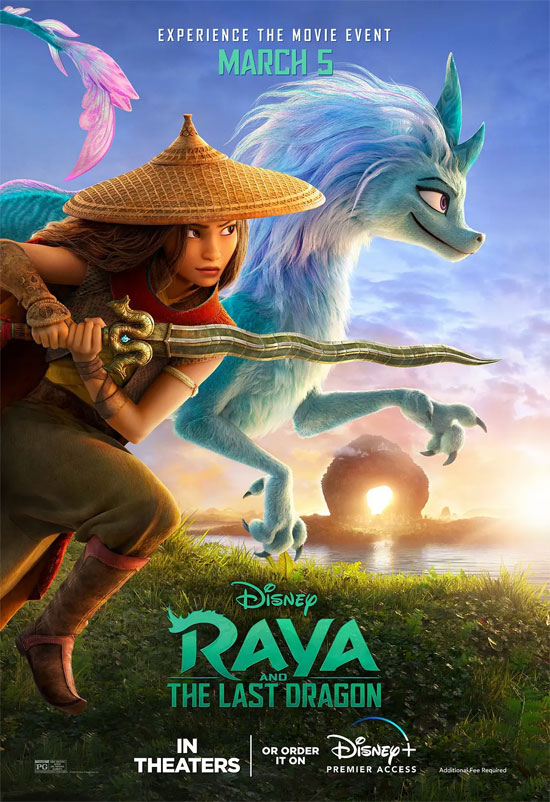
Disney’s new release “Raya and the Last Dragon” is a solid, middle-of-the-road film—nothing particularly standout, yet nothing majorly lacking either. It boasts a commendable theme of “trust,” a marketed selling point as “Disney’s first Southeast Asian princess,” an innovative pet character “Tuk Tuk,” and top-notch production values. All told, it’s essentially a safe bet. But it’s certainly not among Disney’s finest.
Compared to Disney’s finest like “Zootopia” and “Coco,” “Raya and The Last Dragon” clearly lacks a certain captivating quality: the suspense of the unknown. This biographical-style film lets you predict the ending from the start. Release the demon? Of course you’ll defeat it in the end. Petrify the father? Of course he’ll be restored. It’s like playing a video game where you already know the main storyline—the only remaining fun lies in finding minor variations in different levels.
Trust emerges as a central theme. This choice is particularly apt, especially in today’s pandemic-affected world and beyond, where global mutual trust is crucial for rebuilding international order. The film’s demon lacks physical form or a face, much like a plague—intangible yet terrifying. Yet people of different races and regions must unite and trust one another to defeat this demon. One could even say this petrifying demon is actually a human psychological demon, one that can only be dispelled by trust. While the creators of “Raya and the Last Dragon” surely didn’t foresee the COVID-19 pandemic when they first conceived the film, its release timing couldn’t be more timely.
The film depicts three distinct forms of trust. The first resides within the protagonist, Raya. Her character arc is stark: as a child, she held innocent trust; betrayal shattered it, leaving her distrustful and skeptical of help; ultimately, she rediscovers trust—a matured, tested faith. She is a natural optimist, with seeds of trust and compassion planted deep within her heart. Even betrayal merely buried these seeds—it never extinguished them. The flame of trust for others always smoldered within her. Precisely because of this, when the seed was finally reawakened, it erupted with immense power and profound influence.
The second type is embodied by the antagonist Namari. She is a betrayer, utterly pragmatic, and a born skeptic. By the film’s end, this realist who distrusts others also embraces the idealistic emotion of trusting others—representing a certain type of person in real life. This is especially evident in the pivotal scene where everyone is petrified and Namari faces a critical choice. Ultimately, she chooses to trust. When she awakens from her petrified state and first meets Raya’s deeply affectionate gaze, it feels as though the entire world has transformed for her. This profound experience of trust emerging from nothingness is truly moving.
The third type of trust resides in the dragon Hisu. This innocent dragon, through its pure and unconditional trust in humanity and in Raya, ultimately reawakens the seed of trust within her heart. Rather than Raya teaching Hisu to integrate into society, it is Hisu who subtly guides Raya back to her authentic self. The trust it embodies differs from both Raya’s and Namari’s. Raya lost her trust because she subconsciously demanded reciprocity for her own trust. Namari lacked trust because she feared betrayal. Sisu’s trust, however, is unconditional—it seeks nothing in return, trusting purely and simply.
These three forms of trust complement each other, intertwine, and mutually reinforce one another, creating layers of depth and diversity.
Beyond trust, two other emotional elements in the film deserve attention. One is the bond between father and daughter. Though her father left her, I never felt Raya lacked paternal love or felt abandoned while watching. It felt as if he never truly left her spirit. This concept is encapsulated in the idea that “the people you love become a part of you.” Raya inherited not only her father’s blood but also his courage, selflessness, compassion, and devotion. Her trust, deeply ingrained and impossible to shed, was inherited from him.
The other is the antagonist’s emotional journey. Namari betrayed Raya—she was flawed—yet ultimately achieved self-redemption. Making mistakes, even repeated ones, isn’t the worst thing. What’s truly frightening is refusing to confront one’s flaws and errors. As long as one can redeem themselves, society can still embrace them. This concept deserves greater consideration in Chinese animation. We often deny villains the chance for redemption, condemning them outright—yet this rarely yields the most impactful conclusion.
Another major selling point of this film is its Southeast Asian cultural elements, touted as introducing the region’s first princess. Frankly, this pitch feels rather contrived. Why would audiences seek out a Southeast Asian princess? Primarily, they’re drawn by the name “Disney.” The creative team traveled to multiple Southeast Asian countries—Laos, Indonesia, Thailand, Vietnam, Cambodia, Malaysia, and Singapore—to gather inspiration, incorporating elements like martial arts, cuisine, clothing, and architecture. Unfortunately, this fusion feels like a hodgepodge. The original intent was for Southeast Asian audiences to identify with this work and its princess. Yet the overly complex cultural borrowings diluted each element’s authenticity, ultimately failing to foster genuine connection. Thai viewers might remark, “This isn’t Thailand at all.” Rather than this approach, it would have been more effective to deeply explore the culture of a single nation.
The Disney Princess series has consistently drawn inspiration from cultures across the globe and among diverse ethnicities, aiming to ensure audiences everywhere can experience the joy conveyed by Disney works and find something to relate to. This is a grand dream and a grand ambition. But does Disney genuinely care about these foreign cultures? Probably not. If it truly loved Chinese culture, why release only one “Mulan” and not a second or third Chinese princess? Because one was enough to give Chinese audiences a point of identification. Similarly, I’m almost certain Disney won’t release another Southeast Asian princess for decades.
So the hype around Southeast Asian cultural representation shouldn’t be overemphasized. What deserves greater attention—and lessons to be learned—is why audiences in some Southeast Asian regions didn’t connect with Raya and the Last Dragon as expected.
Please specify:Anime Phone Cases » Raya and The Last Dragon 2021 Animation Film Review: Trust dispels inner demons