Film Name: 妙先生 / Mr. Miao
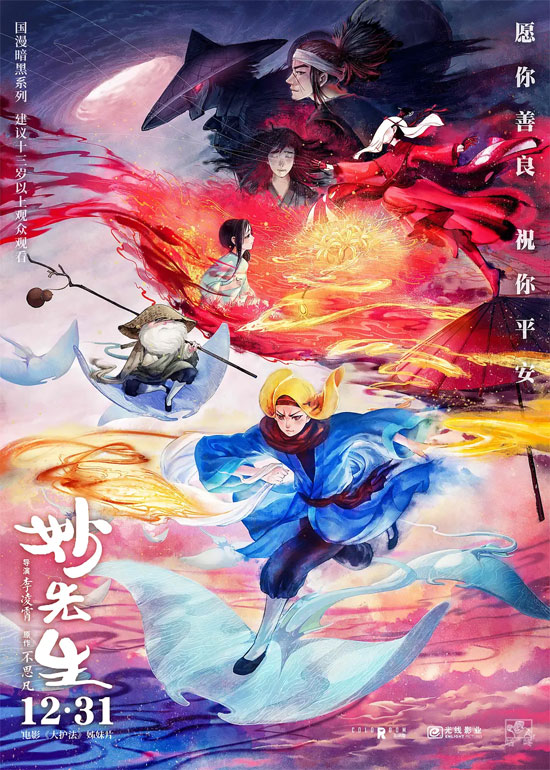
Finally stepping back into the cinema, the long-missed big screen, the long-missed play of light and shadow in the darkness, the long-missed opportunity to reflect on our own world’s events through stories from another time and place. Whether the film is called Mr. Wonderful or not, this feeling is simply wonderful.
Mr. Wonderful is a series of short films created by director Shi Si Fan around 2014. In truth, Mr. Wonderful never actually appears in the shorts, nor is much said about him in the films. He is merely described as the faith of all Seekers—a group of truth-seekers endlessly pursuing the world’s mysteries. So why use “Mr. Wonderful” as the title? Because he might actually be the director’s own faith—the wellspring of all his creativity, the origin of his contemplations on human nature, good and evil, life and death. Mr. Wonderful is like a deity created by Bu Si Fan: never appearing, yet omnipresent. He created the Higanbana that brings calamity, yet also devised the method to avert disaster and eradicate the flower. He is the source of the world’s good and evil, of cause and effect—how could this not be wonderful?
Though not directed by Si Fan himself, the film retains much of his eccentric genius’s spirit, even if some of its vitality is lost. For instance, it faithfully recreates Bu Si Fan’s signature three settings for conveying mystery: primeval forests, intricate alleyways, and cavernous caves. These spaces—with hidden creatures lurking in the woods, blind corners in the labyrinthine streets, and winding passages in the depths—evoke a profound sense of mysticism.
While the film’s marketing heavily emphasizes its “dark” aesthetic, I find that beyond the opening scene where the brother suddenly kills his sibling, most of the film isn’t particularly dark at all—it’s actually quite bright. It doesn’t tell its story through the ugliness of human nature, but rather invests time and energy in depicting humanity’s goodness. Its so-called “darkness” is actually a form of mysticism, a sense of mystery built through its worldview and visual symbols. Much like Spirited Away, from Mee’s Forest to Dahufa and Mr. Miao, the works of the Bu Si Fan studio consistently employ enigmatic elements to spark questions in the audience: “What is this?” and “Why does it exist?” These questions then propel viewers to keep pursuing the story.
The film’s promotional campaign also touted a slogan designed to shock: “Kill the good to save the bad.” Those who haven’t seen the film won’t grasp its meaning, but viewers will understand it instantly. The Higanbana parasitizes within the bodies of good people, yet it brings calamity to those around them, stirring greed and evil in everyone except the host. Once the Higanbana is expelled, these individuals recover, and the world becomes a better place—but at the cost of the good person’s life. Thus, the protagonist Ding Guo’s mission is to save countless villains by sacrificing one righteous soul. Naturally, expelling the Higanbana requires the good person’s willing consent.
This is undoubtedly the film’s most creative aspect, yet I believe it’s also its most problematic. From the outset, it erases the moral dilemma by presenting a single solution. The true dilemma Ding Guo faces is whether to kill one good person to save many bad ones—a choice where any action carries significant cost. How Ding Guo navigates this dilemma reveals his humanity and reflects the director’s values. Yet in the film, Ding Guo treats killing the good to save the bad as a matter of course, something routine. Instead, he shifts the dilemma onto the victims—the good hosts of the Amaryllis—forcing them to decide whether to sacrifice themselves for others. No matter their choice, Ding Guo can respond with detached superiority. This undermines the film’s potential to fully explore its profound ethical questions of good versus evil and life versus death.
Equally underwhelming is the resolution for the Laughing Man. This pivotal character from Master Miao’s short story—a man who never smiles, inherently good yet trapped by obsession—remains underdeveloped. Ding Guo, who genuinely seeks to save lives, offers nothing beyond a chaotic fight scene for the Laughing Man—the one truly deserving of rescue. Did the Laughing Man ultimately laugh? If he didn’t achieve death through laughter, what meaning does his life of never laughing hold?
The film adapts and expands upon a short story from years past, yet loses its way in this very process. It fails to capture the truly gripping humanity at its core. A plot shrouded in fog and muddled editing reduce its mysticism to mere pretentiousness. Thus, both Ding Guo and the film itself remain a long way from achieving the true “killing the good to save the bad.”
Please specify:Anime Phone Cases » Mr. Miao 2020 Animation Film Review: A journey of “killing the good and saving the bad” that was far from over