Film Name: 罗小黑战记 / The Legend of Hei
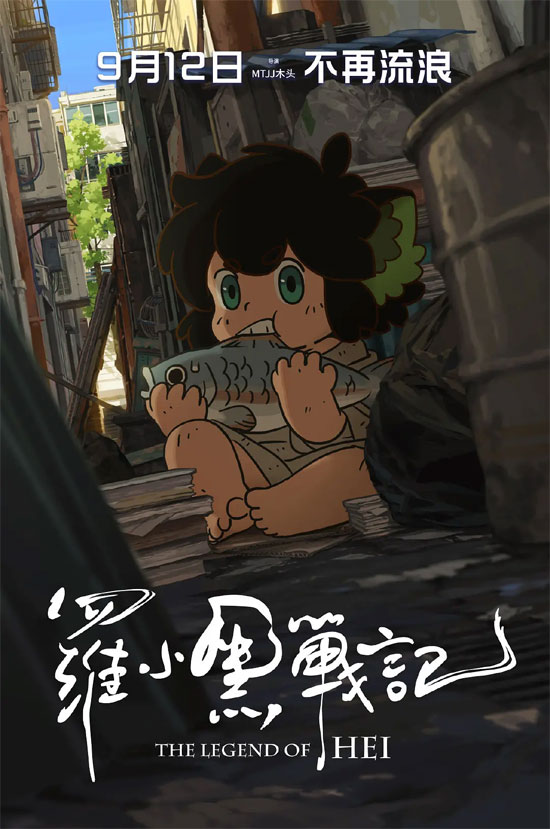
British author Cressida Cowell wrote a novel titled “How to Train Your Dragon,” which was later adapted into the animated film “How to Train Your Dragon” by DreamWorks Animation. In a sense, “The Legend of Hei” also tells the story of how humans tame and assimilate demonic beings—a different species—in a world where various species coexist. The difference lies in the portrayal: “How to Train Your Dragon” features the iconic scene where Hiccup touches Toothless with his fingertips, creating a heartfelt human-dragon connection. In contrast, “The Legend of Hei” uses a straightforward, violent approach—a clash that sparks an unexpected bond—to introduce the interaction between the young Hei and the human named Wuxian.
I find this animation to be an exceptionally brilliant psychological case study, with its core theme being Stockholm Syndrome. In essence, it’s the story of a captive falling in love with their captor.
Social psychologists analyzed a 1973 bank robbery in Stockholm, Sweden, to identify a psychological phenomenon: victims sometimes develop emotional bonds with their captors, fostering affection and dependency. When confronted by a ruthless killer who threatens life at any moment, hostages gradually entrust their survival to this predator. As time drags on, every morsel of food, sip of water, and breath taken by the hostage is perceived as an act of mercy and compassion from the terrorist. Fear toward the abductor transforms into gratitude, even reverence. Evolutionary psychology offers another explanation for Stockholm Syndrome: newborn infants form emotional attachments to the nearest capable adult to maximize their chances of survival.
If Luo Xiaohui is that newborn infant, then Fengxi and Wuxian, whom he encounters successively, are the closest, most powerful adults. It was “kidnapped” by both of them, and these two captors provided it with food and shelter. As a result, Xiaohei developed gratitude, dependence, and admiration toward them. The film particularly focuses on Wuxian, detailing how he “kidnapped” Xiaohei from the island. Forced to coexist on a small boat, Xiaohei gradually transitions from fear and resistance to submission and dependence on him.
The film masterfully incorporates several key conditions for Stockholm Syndrome to take effect. For instance, the hostage must believe escape is impossible; during captivity, they must recognize the captor’s occasional acts of kindness; and the hostage must be isolated from all perspectives except the captor’s. Observe how Luo Xiaohui, after multiple failed escape attempts, ultimately accepts that he cannot evade Wuxian’s grasp. When Xiaohui falls into the water and cannot save himself, Wuxian timely extends a helping hand. During the lengthy voyage adrift at sea, Xiaohui has no access to any external information beyond Wuxian. Even when encountering other demons, they are all Wuxian’s associates.
Thus, Xiaohei’s eventual domestication by the human known as Wuxian was an inevitable outcome. Humans can be tamed, and demons even more so. Yet Fengxi, having reached adulthood, refused to be subdued, while Xiaohei, still in the formative stage of emotional and intellectual development, proved far more susceptible to external influences. Thus, at the film’s conclusion, when Xiaohei wails and refuses to leave Wuxian, this contrived tearjerker moment failed to move me. I would have preferred Xiaohei and Wuxian to part reluctantly, for Xiaohei to carry the memory of this human’s existence, yet spiritually break free from dependence on Wuxian sooner to grow more independent and mature. Sometimes, a separation tinged with regret can be more moving than a perfect reunion. Consider Spirited Away: if Chihiro and Haku hadn’t parted ways at the end, the story would have felt rather ordinary.
What makes this film unique is that the “kidnappers” ultimately develop feelings for their “hostage,” transforming the Stockholm Syndrome dynamic into a mutual bond rather than a one-sided attachment. Yet this very aspect also becomes the film’s greatest regret. It fails to reveal how Luo Xiaohui’s presence within Wuxian’s world transforms him personally. Did he learn to love? Did he resolve some inner conflict? If he remains cool from start to finish, the film lacks that truly heart-wrenching moment. In truth, dedicating just five minutes to explore Infinite’s backstory—why he possesses such power, why he chooses to aid demons despite being human—would have made him a far more multidimensional character. Audiences can only fully grasp a person’s present by understanding their past. Xiaohei’s presence undoubtedly casts a pebble into Infinite’s tranquil pond, stirring long-forgotten ripples that eventually swell into a tidal wave powerful enough to transform and mature him.
Xiaohei shifts between cat and human forms. This transformation shouldn’t be arbitrary but deliberate. Personally, I believe it should be a cat when untamed and human when tamed. Its shift from cat to human isn’t evolution but domestication.
The “Field” is a crucial and intriguing concept in the film, representing a protective mechanism that is essentially a psychological defense. The field Fengxi creates actually provides him with a sense of psychological comfort. Unfortunately, the film fails to fully realize the concept of the “Field.” First, from a physical perspective, when Xiaohei first unleashes his field, the waves are repelled, indicating that the field’s expansion is a process of exclusion. Later, when Fengxi activates his Domain, it expands to envelop the city without repelling anything—a contradiction. Secondly, Fengxi and Wuxian fight to a standstill within the Domain, which starkly contradicts the premise that a Domain master is “godlike” within their own space. Logically, Fengxi should have overwhelmed Wuxian completely. Only by pushing Infinite to the brink could his profound sacrifice—knowingly entering the domain to save Xiaohei despite the impossibility—truly shine. Only then would Xiaohei’s resurrection gain profound value, delivering that thrilling last-minute rescue reversal. Finally, the film fails to fully leverage the narrative ingenuity of the “domain” concept. Infinity possesses his own domain. What if he had used his spatial magic within Fengxi’s domain to enter his own realm? This is undoubtedly what audiences would have loved to see.
Overall, however, the film maintains the signature style of the “The Legend of Hei” animated series: subdued colors, fluid action sequences, and a beautiful soundscape. Every corner brims with imaginative imagery, symbols, and scenes, making it a high-quality 2D animated film. In a market dominated by 3D animations, it stands out as a refreshing breeze. Particularly captivating is the sequence where characters from traditional Chinese paintings come to life, offering a truly enchanting experience—a magic only animation art can deliver. While the plot density and logic may fall slightly short of what “Little Black” fans might expect, these minor flaws do not overshadow the film’s overall brilliance.
Please specify:Anime Phone Cases » The Legend of Hei 2019 Animation Film Review: The Taming of Demons