Film Name: 江海渔童之巨龟奇缘 / A Fishboy’s Story: Tortoise from the Sea
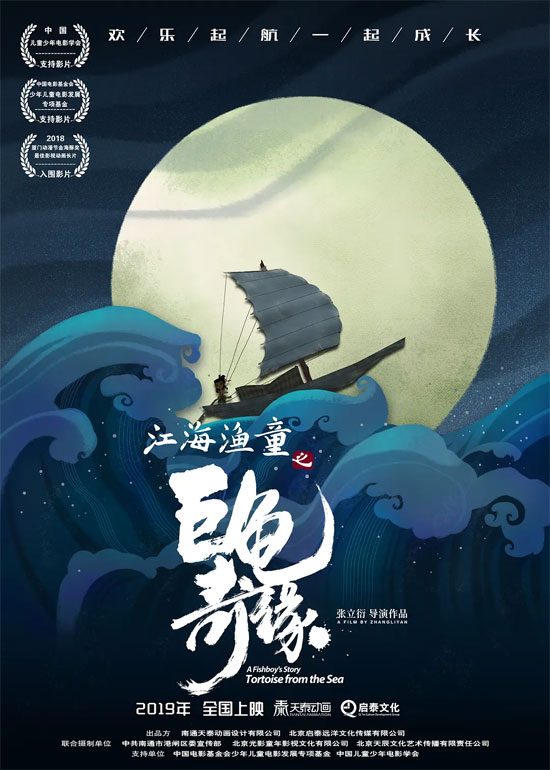
Films daring to premiere around “315” Consumer Rights Day typically need to have something special. Even those skeptical of “A Fishboy’s Story: Tortoise from the Sea” will likely find it a worthy tribute to this occasion—a film that transcends lowbrow humor and delivers genuine sincerity. With its unpretentious yet passionate narrative, clean yet distinctive art style, and delightfully folksy songs, the film brought me a breath of fresh air.
Frankly, the visual style of “A Fishboy’s Story: Tortoise from the Sea” is unprecedented in Chinese animated films. It employs a CG-rendered paper-cut aesthetic reminiscent of the Irish masterpiece “The Secret of Kells.” Scenes like the coastal fishing village’s mountain vistas and the heartwarming reunion between boy and turtle beneath fiery sunset clouds left me with profoundly beautiful impressions.
Unlike the elaborate ocean renderings common in big-budget CG films, this movie abstracts the sea and waves into two-dimensional forms. The result is surprisingly light and effective—those simple triangular waves actually highlight the charm of animation’s unrealistic quality. While the global animation industry races to emulate American studios in CG effects and hyper-realistic modeling, this film reawakens our appreciation for the beauty of simplicity and abstraction. Such a reunion feels long overdue. I hope this distinctive style becomes the director’s signature and is consistently upheld.
The opening thirty minutes employ flashbacks and diverse cinematographic techniques, masterfully building emotional resonance and laying groundwork for details—even showcasing a level of refinement rarely seen in domestic animation. For instance, at the fishing village market, brief lines from minor characters vividly reveal their personalities. The wife of a burly fisherman, seeing him off to sea, says, “Don’t give away all the rice—keep some for yourself.” This reveals the fisherman’s generosity and selflessness. Another mother, holding her child, remarks upon the child’s fascination with a windmill, “Blowing is free.” This highlights the mother’s thriftiness. Even more commendable is how the film’s design shines through in later scenes, where earlier details—like the innkeeper and clerk’s banter or neighbors’ street conversations—resonate with subsequent plot developments.
Yet we must also acknowledge that the film’s later expansion, particularly the final thirty minutes, reveals a noticeable decline in narrative control. When the three plot threads converge—the fisherman’s quest to defeat the sea monster, the young protagonist Manjiang’s bond with the giant turtle, and the unscrupulous merchant Ma’s scheme to seize the fishing village’s resources—the film feels somewhat strained. Relying on the helpless cries of the young protagonist Manjiang to move the audience only highlights the screenwriter’s own sense of helplessness at this point.
In my previous articles praising “Shaoshan Youths – The Story of Chairman Mao,” I’ve already stated that what ultimately moves us isn’t the protagonist’s sacrifice, but the awakening of others. Mao Zedong’s words and actions compelled even profit-driven landlords to open their granaries and distribute grain—what kind of influence is that? What I truly wanted to see was how the villagers, inspired by the bond between Manjiang and the giant turtle, would act. I even longed to witness the expression of shame and self-reproach on Boss Ma’s face if he had fallen into the water, learned his lesson, yet been saved by the giant turtle. At emotional turning points, beyond depicting the protagonist, we must pay attention to portraying the reactions of others—using their transformations to highlight the protagonist’s righteousness. After all, every audience member is an “other.”
What Boss Ma sought was red coral, yet he never even touched it. This clearly spared the protagonist from facing the most critical peril, thus preventing the film from achieving its most cathartic expression at the climax. Had the film allocated more of the sweeping cinematography used in the fishing village scenes to depict the red coral’s grandeur, preciousness, and mystique, this environmentally themed film would gain greater resonance. Boss Ma’s plundering and destruction of the coral would also provoke deeper reflection among viewers. This would have felt far more natural than the abrupt “bombing of the giant turtle” scene.
The film’s character color schemes require more careful consideration. While the red tones for Man Jiang largely reflect his personality, the green palette for Boss Ma and his henchmen feels misplaced. Convention dictates a dominant black palette, complemented by deep grays and purples. Having the villains and fishermen share the same color scheme risks creating visual confusion for the audience.
Manjiang appears excessively isolated in the film, yet he isn’t portrayed as a lone hero. The two other children could have served as his allies—otherwise, why include them at all? When Manjiang faces challenges, he should have companions besides the giant turtle to guide and support him. Relying solely on the protagonist’s spontaneous awakening feels somewhat self-serving. Furthermore, having lost both parents to the sea, Manjiang’s fear of the ocean should be profound. Yet the film glosses over his ultimate psychological barrier—fear of water and the sea—with surprising ease. This simplification is rather disappointing.
Please specify:Anime Phone Cases » A Fishboy’s Story: Tortoise from the Sea 2019 Animation Film Review: Awaken the beauty of simplicity and abstraction