Film Name: 小猪佩奇过大年 / Peppa Celebrates Chinese New Year
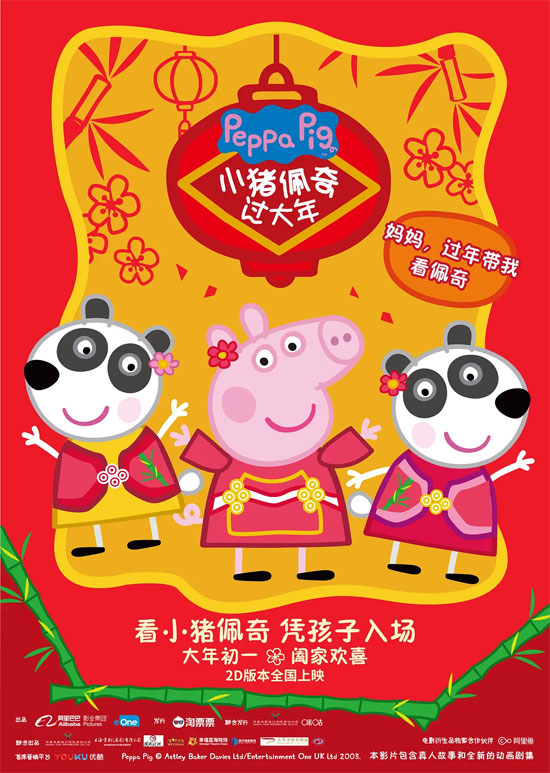
The release of the “Peppa Pig” movie during the Chinese Lunar New Year of the Pig was nothing short of a highly anticipated event. Countless Chinese children have practically memorized the dialogue from multiple seasons of the animated series, while countless parents have watched every episode alongside their kids, developing a certain psychological attachment to this little pink pig. Even more Chinese manufacturers, seemingly unaware of why Peppa has become such a phenomenon, have secured licensing rights for the film, hoping to cash in on merchandise.
I was also eagerly anticipating it. My main curiosity lay in how an animated series targeting preschoolers would translate to the big screen. After all, the five-minute episodes of “Peppa Pig” on TV or mobile devices must differ significantly from an 80-minute feature film. We know that younger children have shorter attention spans. That’s precisely why “Peppa Pig” episodes are five minutes long—young children simply can’t sustain focus for longer. Yet a feature film must run at least 80 minutes. How does it captivate preschoolers throughout? How does it tell a story? This is actually the film’s most compelling technical challenge—and potentially its greatest insight for China’s animation industry.
Yet upon leaving the theater after watching the film, I felt a considerable sense of disappointment. The approach of linking several 5-minute animated segments with live-action scenes felt remarkably crude. The lengthy live-action opening sequence made me wonder if I’d entered the wrong theater, and the live-action interludes throughout felt jarringly out of place. To put it lightly, it seemed the film relied on the children’s attention lapses during the live-action segments to keep them focused on the animated parts.
In fact, “Peppa Pig” released a 72-minute animated film in the UK back in 2017. That version also used live-action segments with Peppa Pig puppets to bridge the segments, but the results were disappointing. Many parents who watched it were unimpressed, calling it a ‘lazy’ and “disgusting” film. Criticisms centered on two main points: the live-action segments lacked immersive appeal, and the film’s interactivity fell far short of its promotional claims.
Given the known failure of the 2017 test, I believe the decision to release a similar film in the Chinese market in 2019 truly undermines this premium children’s brand. The Chinese release of this animated film even removed the sole source of childlike charm from the British version—the Peppa Pig puppet—replacing it entirely with live actors. While this live-action family also features two children, a sister and brother pairing, these two—who may be meant to symbolize Peppa and George—can never replace the real Peppa and George in children’s hearts.
The animated segments in the film could be described as rather “lazy,” as the vast majority are reused episodes from previous broadcasts. It’s worth noting that the UK version of the film featured animated content from episodes that hadn’t yet aired at the time. Only the final animated story, “Chinese New Year,” is newly created. While this five-minute segment is quite good—maintaining Peppa Pig’s signature fast pace, three educational points, and consistent color palette and language style—its brevity pales in comparison to the 80-minute runtime. Audiences can’t help but feel the film offers far too little genuinely fresh content.
The film deliberately adopts a Hollywood-Broadway style, frequently inserting live-action singing and acting sequences. It seems sophisticated but is actually quite tacky. In my view, having live actors sing and dance in an animated film is a clear misdirection by the director. Disney’s Broadway approach involves animated characters singing and dancing, brimming with imagination—a dual feast for the eyes and soul. Having live actors perform these roles is putting the cart before the horse. The film attempts to use the glitzy Broadway spectacle as a crutch to compensate for its lack of animation, hoping these songs will sustain children’s attention. This tactic rarely succeeds.
The film’s biggest narrative flaw is gathering both sets of parents for the New Year celebration only to mock the tension between mother-in-law and mother-in-law. This is deeply jarring for Chinese audiences who cherish and prioritize family reunion. Why, in an animated film released during the Spring Festival period, would it deliberately depict the subtle discord between the husband’s and wife’s families? With so many beautiful, harmonious aspects of family life to portray, it insists on focusing its brushstrokes on this point—and it’s not even humorous. I even feel this plot device severely undermines the worldview and brand value of “Peppa Pig,” as it doesn’t stand up to scrutiny. Are families who love Peppa Pig really like this?
Thus, “Peppa Celebrates Chinese New Year” can already be deemed a failed animated film. Its box office revenue hasn’t reached 100 million yuan after three days of release, with screenings steadily declining. This outcome could be seen as either abnormal or normal. It’s abnormal because this box office performance falls far short of reflecting Peppa Pig’s current popularity in the Chinese market, especially considering the buzz generated by the promotional video “What is Peppa?” before the film’s release. The normality lies in this box office figure reflecting the spontaneous choice of audiences and the market. Films that rely solely on brand name without quality cannot “fool” the market or ‘deceive’ viewers. If more films like “Peppa Celebrates Chinese New Year” are produced, Peppa might truly have a rough time in China.
While this film didn’t provide answers to the question of “how to make quality movies from low-age animation,” it still offers Chinese animation professionals some cautionary insights.
First, the protagonist must be a character children want to see. If “Peppa Celebrates Chinese New Year” had featured Peppa Pig—even as a puppet—the effect would have been far superior to the baffling pair of live-action children.
Second, prioritize animation’s core essence. While young children might theoretically struggle to distinguish live-action from animation, they instinctively recognize the difference visually. They enter theaters primarily seeking animation’s unique imaginative space. Therefore, even when blending live-action with animation, the animated segments should dominate the narrative. To quantify this, animation should constitute at least 80% of the runtime.
Please specify:Anime Phone Cases » Peppa Celebrates Chinese New Year 2019 Animation Film Review: Don’t let Peppa miss out on the New Year celebrations.