Film Name: 哆啦A梦:大雄的金银岛 / Doraemon the Movie 2018 Nobita’s Treasure Island / Doraemon Nobita no Takarajima / ドラえもん のび太の宝島
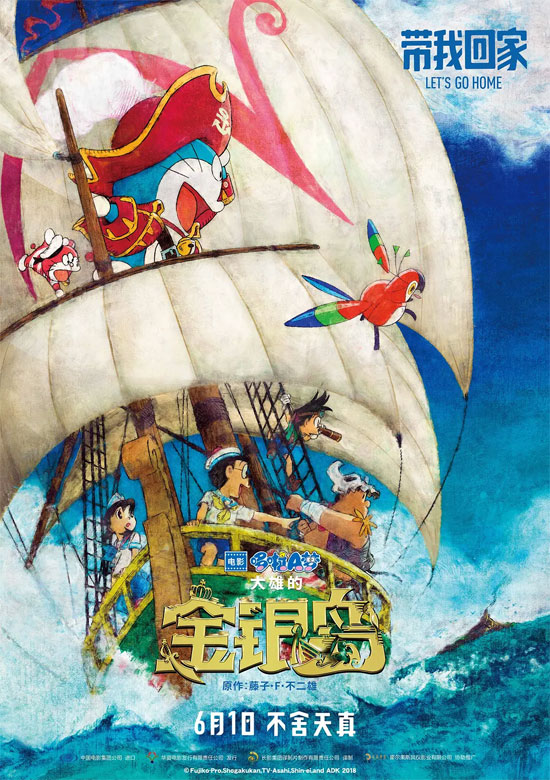
Written by Genki Kawamura and directed by Kazuhiro Imai, this new Doraemon film, “Doraemon the Movie 2018 Nobita’s Treasure Island,” can truly be called the biggest disaster in the series’ history. Clearly, these two creators—neither of whom had ever written or directed a Doraemon feature film before—have produced something utterly incongruous: a work that has lost the essence of Doraemon and even betrays the spirit of the original. As a commemorative work for Fujiko PRO’s 30th anniversary, it achieved box office success but is far from satisfying.
The biggest problem lies in the portrayal of Nobita. From the very start, Nobita displays an extravagant series of exaggerated physical antics—leaping wildly over concrete pipes in a small park, or performing a ballet-like pirouette on the spot to greet Doraemon’s gadget. Frankly, after watching Doraemon for over 30 years, I’ve never seen such a Nobita Nobi.
What should Nobita be like? He’s the kind of kid who trips over a pebble while walking down the street. In the 1998 film “Doraemon: Nobita’s South Sea Adventure” (which also served as a reference for this adaptation), he lies on the ground blowing on a flame only to cough violently from the smoke—that’s Nobita. He possesses zero athletic talent and is practically useless, which is precisely why he needs Doraemon’s help. This is a fundamental aspect of Doraemon’s core concept. This core trait remains unchanged over time. Altering it would undermine the very foundation of the Doraemon universe. In other words, actions like leaping around or dancing ballet are utterly foreign to Nobita. Clearly, both Genki Kawamura and Kazuhiro Imai overstepped the original’s boundaries with their bold reinterpretations.
What about Doraemon himself? For over 30 years, a timeless convention in Doraemon’s TV series and films has been this: when Doraemon unveils a new gadget for the first time, the camera zooms in for a close-up, flashes appear in the background, Doraemon shouts the gadget’s name, and the music swells with a short, exhilarating melody. What do we watch Doraemon for? Beyond the dramatic stories fueled by the protagonist’s quirky personality, it’s largely to see these colorful, imaginative gadgets that reflect human desires. The conventional setting for their introduction should be strictly adhered to. Unfortunately, this film seems to have overlooked this point. When the multitude of Mini Doraemons appeared, I couldn’t tell if they were Sun Wukong or Naruto Uzumaki’s abilities.
Meanwhile, the film’s plot is truly lamentable. The ultimate villain Silver’s motive for destroying Earth is utterly implausible. Had Nobita not insisted on venturing to Treasure Island that day like a man possessed, the planet would have been obliterated without anyone noticing. His two pirate henchmen, Bibbi and Kakka, are pure Akira Toriyama-style characters, completely out of place in the Doraemon universe. The resemblance between Sara and Shizuka turns out to be purely coincidental, yielding no further plot development. A mere elementary schooler, Flock, explains his programming prowess surpassing his father’s with the line, “I taught myself mechanical engineering.” Doraemon’s headbutt manages to crack the high-tech protective shield of Silver’s spaceship. Director, just how much do you underestimate the audience’s intelligence?
Most crucially, what exactly is the connection between Treasure Island and Silver’s spaceship? While the setup where Nobita’s treasure hunt ultimately yields not riches but the treasure of family bonds is commendable, why would Silver’s ship contain the very gold and silver treasures described in the book? And what was the point of the scene where coins rained down from the sky as the ship vanished? Was it meant to flaunt, “I can’t even hold all the ticket money, so here’s a little something back for you”?
Compared to the 1998 predecessor, this film falls short in narrative flow and logical coherence. It feels like a production from Zheguang Animation—everything just makes no sense. After such a grand adventure, what state would the children be in when they returned home to their parents? The 1998 “South Sea Adventure” depicted this in its ending credits, yet this installment omits it entirely. Instead, it awkwardly inserts a preachy lesson about parent-child relationships—a complete misstep. Beyond the single touching moment where Nobita leaps to save Doraemon, the entire film offers little else of merit.
Please specify:Anime Phone Cases » Doraemon the Movie 2018 Nobita’s Treasure Island Animation Film Review: A Disaster in the History of Doraemon Films