Film Name: 大护法 / Dahufa
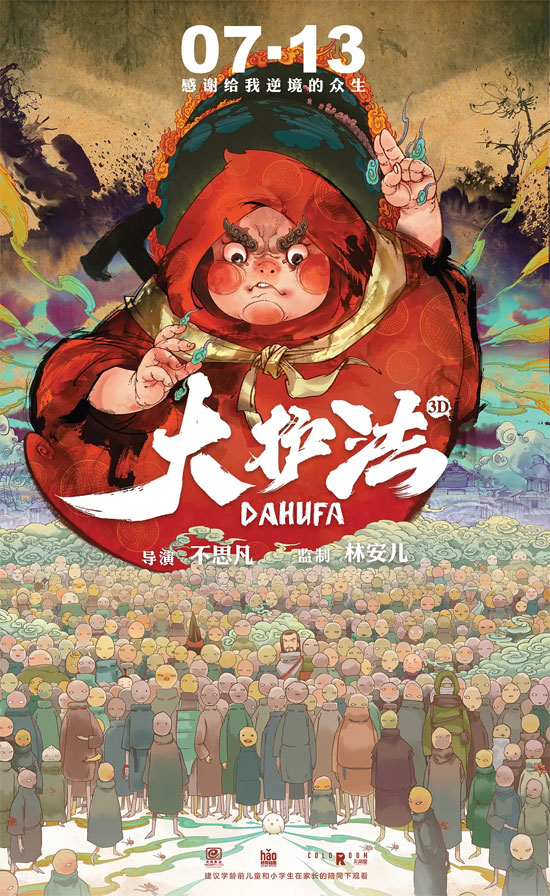
Regardless, seeing a feature-length animated film by director Bu Si Fan on the big screen during my lifetime brings a small sense of satisfaction. As a director with a distinctive style in character design and color palette, Bu Si Fan is one of the few instantly recognizable animation directors in China. Of course, what’s even more recognizable is his particular expertise in crafting mystical narratives.
The film’s two-dimensional color palette and fluid, dynamic animation are truly remarkable. The pervasive sense of mystery seeping from the visuals, character designs, and cinematography is richly layered, and the film’s unraveling of this enigma achieves a high degree of fluidity. The story of The Guardian, originally intended to unfold over 20 episodes like the forest in Xiao Mi, has been highly condensed into a 90-minute film—an effort and its outcome that deserve praise.
The three mystical realms envisioned by director Bu Si Fan—the primeval forest, the intricate alleyways, and the cavernous caves—are all explored within the film. The forest teems with eerie creatures that may not pose direct threats, yet their endless presence as unseen observers is enough to keep one constantly vigilant. The streets certainly aren’t wide, eight-lane boulevards like Chang’an Avenue. Instead, they’re a jumble of staggered houses and narrow alleys—the only way to create countless hiding spots and blind spots. Naturally, the ultimate enigma unfolds within cavernous caves. These are nothing like the straightforward, unpretentious dwellings of Yan’an; they are labyrinthine and intricate, winding through twists and turns. Only such depths could conceal secrets too intimate for the world to know.
This mystique is further amplified by the film’s deliberate placement of triggers that make the audience internally ask, “What is this?” and “Why is it like this?” From the giant black peanut floating in the sky, to the oddly shaped peanut people, to the numbers above the tunnel entrance, and the little peanut people with pinwheels pinned to their backs—you might find yourself questioning it all. Similarly, you’ll find yourself subconsciously pondering: Why is there a butcher here? Why do the peanut people wear false eyes? Why do they take on that form at night? In truth, audiences aren’t particularly interested in philosophical questions like where the peanut people come from or where they go. Instead, they’re drawn to the surface-level enigmas. It’s precisely these mysterious puzzles that keep viewers utterly captivated.
This is also a work about power. The power of religion (or cult) represented by the Old Man, the power of kingship embodied by the Prince, the power of force symbolized by the Great Protector, the power of sexuality personified by the Woman, the power of lineage represented by the Queen Ant, the power of the people embodied by the Peanut People, and the power of secular ideals symbolized by the Butcher Mao—all intertwine and clash. The acquisition, loss, and shifting of power occur in the blink of an eye, with the balance of forces capable of shifting dramatically at any moment.
However, despite the film’s brilliant display of mysticism, it still lacks that classic quality—that truly unforgettable moment that stays with you forever.
You might argue that Xiao Jiang’s death was shocking, but was it truly shocking enough? Amidst such a powerful torrent of power struggles and such an intense mystical atmosphere, Xiao Jiang’s sacrifice as an awakened martyr, though startling and perhaps moving, hardly evokes a profound, heart-wrenching sorrow. He merely becomes a sacrificial pawn in the secular power’s challenge to the monarchy, a spark igniting the monarchy’s awakened suppression of religious authority. Of course, his cryptic rebirth at the end offers some psychological solace to the audience.
You might say that Pao Mao’s death was shocking, but was it truly shocking enough? For such a vocal, constantly wavering character, his death felt like it was merely granted meaning by the Great Protector out of pity. This pales in comparison to the transcendent impression left by the supporting character No-Face in Spirited Away, another masterpiece of mysticism. No-Face utters not a single word, yet its stark contrast between serene stillness and ravenous greed remains vividly etched in memory. A decade later, I likely won’t recall what Bao Mao’s ideals truly were.
Much of the film is consumed by frantic chases and brawls within the cave, deliberately emphasizing the Great Protector’s formidable power through visually jarring violence like decapitations to grab attention. While the intensity of this violence starkly contrasts with the coldness of human relationships—making Jiang and the Prince’s bond seem all the more precious—this accumulation of violent elements significantly encroaches on the film’s potential to further explore its mystique. For instance, the nature of the relationship between the woman and the Spiked Killer, the distinction between Black Stone and Blue Stone, and the source of the Great Protector’s power—none of these receive sufficient time for proper explanation. Truthfully, audiences aren’t particularly interested in how Peanut People get their heads blown off; they’re far more eager to see the unraveling of the film’s enigmatic puzzles.
Of course, as a work of mysticism, a major plot twist would have been a compelling choice. For instance, if the Hidden Witch or Xiao Ming emerged as beneficiaries of Ouyang Jian’s cult collapse, sparking new conspiracies, the film would have achieved a vastly different level of complexity and adult sophistication.
Personally, I’d love to see the tiny black figure Prince painted as the finishing touch on his mountain landscape make a meaningful reappearance. That would clarify the significance of his artistry. Audiences will be disappointed if the mystery ultimately remains superficial without deeper resonance.
Just as Jiang Wen’s “Gone With The Bullets” sparked two diametrically opposed reactions upon release, “Dahufa” is bound to enjoy similar debate. Regardless, as a strikingly distinctive case, I sincerely hope this kind of film, this style, this approach to imagining worlds, finds its audience—or at least secures its place within the realm of art.
Please specify:Anime Phone Cases » Dahufa 2017 Animation Film Review: Brilliant but not timeless