Film Name: 萤火奇兵 / Lighting Dindin
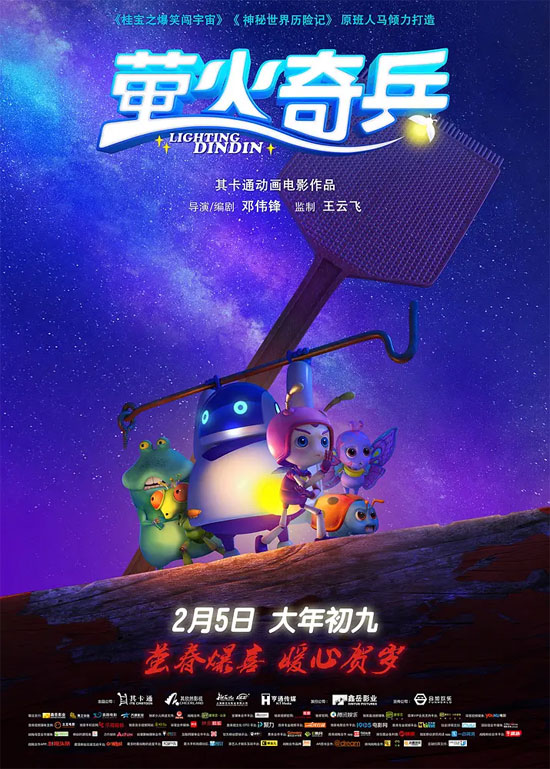
This is a film whose title outshines its content. The words “Firefly Warriors” conjure vivid imagery: vast grasslands bathed in starlight, a river reflecting all earthly beauty, and an enchanting insect world. Amidst this, a swarm of dazzling yellow lights suddenly rises—rivalling the stars, illuminating the river, uniquely luminous among insects. Like the original “Snail Racer,” the title “Firefly Warriors” made me eager to explore this world.
Yet the film’s content falls far short of satisfying me, failing to deliver anything beyond imagination. This tale contrasting fireflies with aliens—though it features touching self-sacrifice, thrilling intelligence and courage, laugh-out-loud humor, and vibrant song-and-dance—leaves me feeling that the imagination surrounding fireflies hasn’t been pushed to its limits. The imbalance between the two sides undermines the contrast, leaving the narrative feeling contrived and artificial.
We typically depict social insects like ants and bees as collective entities, with heroes emerging as exceptional individuals within those groups. They may not possess superpowers, but they always exhibit unique qualities that set them apart from the norm. If fireflies were portrayed within such a collective—positioning Dengdeng as a unique member among countless others, perhaps the smallest, weakest, or one capable of emitting different colors—and contrasted with its peers, that would forge the most compelling hero.
Deng Deng constantly envies robots for their ability to emit more, brighter, and more magnificent light. This envy is akin to a person resenting a computer for calculating faster or remembering more—it lacks a credible foundation. Instead, place it within a community where it stands out as unique, fostering feelings of inferiority. Yet ultimately, it is precisely this distinctiveness that transforms it into a true “wild card.”
The film strives to celebrate light, equating it with hope. Yet true hope lies not in light itself, but in the person who brings it—the virtue that empowers others. The film itself portrays numerous forms of light that scarcely qualify as hope: the flickering of flames, the glow of insect traps, and so on. The film’s exploration of light’s essence remains somewhat superficial, and its portrayal of light lacks focus. Aside from the memorable scene where Deng Deng reignites her firefly light to rescue an energy-depleted robot—a striking depiction of light—it’s difficult to recall any other truly awe-inspiring moments of light.
I longed to see the dazzling yet poignant glow of countless fireflies dancing together in “Tombstone for Fireflies,” to witness the unpredictable play of light in varying hues, intensities, and rhythms, to behold the moving effects of firefly light reflecting on water, grass blades, and others’ cheeks in the darkness. I long to see the stark contrast between the faint glow of a single firefly and the intense blaze of a raging fire… There are so many kinds of light I wish to see, yet the film offers us only the most monotonous kind—a single firefly illuminating the entire story, failing to deliver even a single spectacle.
Personally, I dislike the film’s ending—the scene where Deng Deng causes the tractor’s circuit to short-circuit by sacrificing itself. Though it transforms into a brilliant light at that moment, this light feels somewhat contrived. First, other friends were also striving hard, pressing down on the tractor’s brakes. So was the tractor’s stop truly Deng Deng’s achievement? Second, the other insects in the grass were praying too—did their prayers demand Deng Deng’s sacrifice to resolve the crisis? Third, Deng Deng, charred black after self-sacrifice, is resurrected through the robot’s “black technology.” This resolution feels overly deus ex machina, especially since there’s no prior setup suggesting the robot possesses such life-restoring capabilities. Thus, Deng Deng’s death is hard to accept, and his resurrection even harder to believe.
Of course, these fanciful criticisms don’t detract from the film’s success as a children’s animation. Its wholesome content keeps young viewers thoroughly entertained. But it truly remains confined to this role as a children’s film.
Please specify:Anime Phone Cases » Lighting Dindin 2017 Animation Film Review: The imagination of light that a single firefly cannot master