Film Name: 马小乐之玩具也疯狂 / Ma Xiaole and His Toys
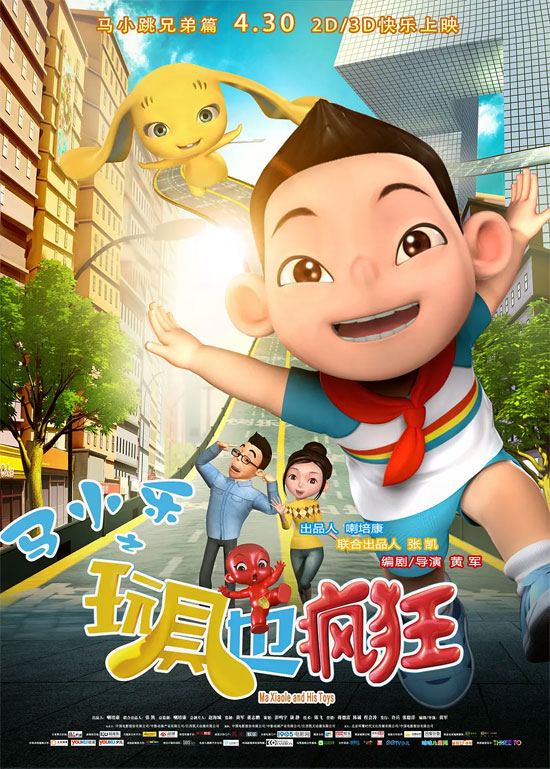
Setting aside the two toy characters in the film—Big Head and Little Yellow Hat—whose ugly designs and clashing colors are enough to make one feel queasy, let’s focus on Ma Xiaole, who desperately wants to break free from his parents’ strict rules and enjoy a happy childhood. Where does his ultimate joy come from?
When it comes to toy-pet themed films, comparisons with “Doraemon” are inevitable. While Doraemon is Nobita’s best friend, the emotional bond between this human and a robot—or rather, an alien entity—only truly shines through contrast with Nobita’s relationships with his human friends. Though weak, Nobita isn’t lonely; he has Shizuka, and even the bullies Gian and Suneo who constantly pick on him. But who is there for Ma Xiaole? Beyond his parents, what is real?
We cannot use one illusion to highlight another. We cannot measure the value of Ma Xiaole’s friendships by pitting two fictional characters—Little Yellow Hat and Big Head—against each other in a contest for affection. This is precisely why the film feels so unrealistic. You may interpret the director’s critique of family education, or view Ma Xiaole’s return to the past and his finding joy in simple rural life as a profound journey of rediscovery. Yet you cannot overlook the crucial psychological growth point missing from Ma Xiaole’s life: interaction with peers.
In a sense, interacting with his childhood father could be considered a form of peer interaction. Yet this misplaced communication carries only symbolic meaning—encouraging parents to become their children’s friends. This plotline is primarily aimed at parents.
For Ma Xiao Le, who constantly insists his yellow hat is his friend, the film starkly reveals the loneliness inherent in being an only child. After finishing homework, his sole desire is solitary video game play. Consider how in “Doraemon,” Nobita’s first act after homework is to play baseball with friends—even if he always loses and gets scolded, he still goes out. Thus, Ma Xiaole fundamentally lacks a genuine need for friendship. At best, he desires a magical companion for idle chatter and wish-fulfillment.
In truth, Big Head consistently mirrors parents’ presence in children’s lives, while Little Yellow Hat symbolizes childhood joy. The scene where Big Head uses his baton to drive away Little Yellow Hat thus reflects the harsh reality of parents perpetually seeking to strip children of their happiness. But is Little Yellow Hat truly the kind of joy children seek? It showers them with sweet talk, solving real-world problems with magic that demands no sacrifice or cost. Its pretense of being incompatible with other children is fundamentally deceptive. Does it offer children spiritual nourishment or spiritual opium? These are questions worth pondering.
The film’s most heartwarming scene occurs when Ma Xiaole glimpses his father’s grandparents in his childhood memories. With minimal strokes, it conveys the profound warmth and tenderness of familial bonds.
The film’s most suggestive element lies in the placement of Big Head’s life shield—a toy’s critical component deliberately positioned at a man’s sensitive area. Multiple scenes depict the protagonist grabbing, poking, tugging, and snatching at the shield. Undeniably, this sexual innuendo-laced consumption of pleasure is the film’s most potent commentary on “toys gone wild.”
Please specify:Anime Phone Cases » Ma Xiaole and His Toys 2016 Animation Film Review: Actually, I have no friends.